 Follow on Google News
Aging Hematopoietic Stem Cells: Clusterin Marks Aging Shift Toward Myeloid and Platelet Production in Stem Cells
Expression of the Clusterin gene in hematopoietic stem cells marks an age-related shift toward myeloid/platelet over lymphoid cell production.
Hematopoietic stem cells (HSCs) can differentiate into any blood cell. However, as HSCs age, they are more likely to differentiate into platelets and myeloid cells. This age-dependent shift is poorly understood due to a lack of marker genes. Now, scientists from the University of Tokyo present the Clusterin (Clu) gene as a novel biomarker of HSC aging. This allows easy identification of aged HSCs, shedding light on the biological mechanisms of aging.
Aging Hematopoietic Stem Cells: Recent Year’s Trend
In recent years, there has been a growing trend of an aging patient population and an increasing prevalence of age-associated diseases, underscoring the need for advancing research into the biological mechanisms of aging. Of particular scientific interest are hematopoietic stem cells (HSCs), which undergo profound age-related phenotypic and functional transformations.
HSCs, found in bone marrow, have the capacity to differentiate into various blood cell types, including red blood cells, different white blood cells, and platelets. However, with age, HSCs become biased toward differentiating into myeloid cells and platelets rather than lymphocytes.
This myeloid/platelet-biased differentiation disrupts normal blood cell production (hematopoiesis) and can contribute to anemia, immune deficiencies, and even blood cancers.
Many studies have explored ways in which aged HSCs can be rejuvenated. These methods are only partially effective because the exact mechanics of HSC aging remain unknown. The lack of ‘reporter systems,’ genes that can visually mark aged HSCs makes it difficult to identify aged HSCs within the HSC population and is a major reason why the aging process is hard to study. The discovery of an effective marker/reporter gene for aged HSCs can clear the initial barriers to understanding HSC aging.
In a groundbreaking study published in the journal Blood on March 25, 2025, a research team from the Institute of Medical Science, The University of Tokyo, led by Professor Atsushi Iwama and Project Assistant Professor Shuhei Koide, has uncovered a significant breakthrough in understanding HSC aging. Through single-cell RNA-sequence analysis comparing young mice (8–10 weeks old) with aged mice (18–20 months old), the researchers identified Clusterin (Clu), a molecular chaperone, as a novel marker capable of functionally categorizing aged HSCs.
Read More
“Our study used Clu-GFP transgenic reporter mice as a model,” Dr. Koide explained. “The expression of Clu also drives the expression of green fluorescent protein (GFP), which acts as a reporter gene and glows green in flow cytometry. This allowed easy identification of aged HSCs and is a more efficient approach than previous studies on other biomarkers, which used antibodies to visualize the marker protein.”
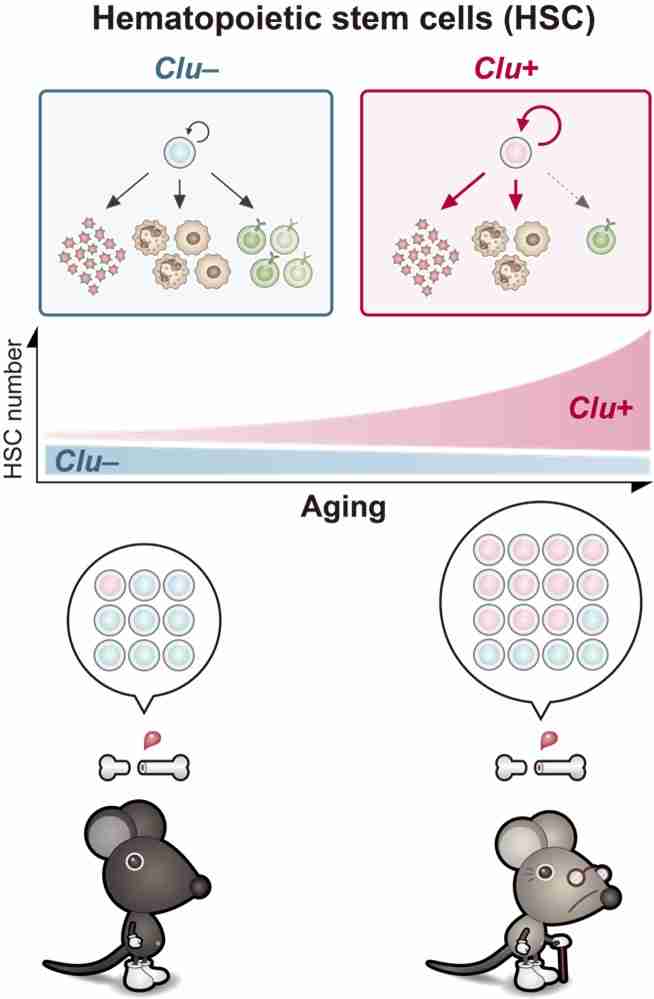
Clu-positive (Clu+) HSCs were found to be a minor population in mice fetuses and expanded with age, explaining the gene’s association with HSC aging. Clu+ HSCs showed an increased propensity towards differentiating into platelets or myeloid cells. In the bone marrow, Clu+ HSCs preferred self-renewal over differentiating into other cell types. In contrast, Clu-negative (Clu–) HSCs showed no bias in differentiation and maintained a balanced cell production approach typical of younger stages. During development, the differentiation of stem cells is crucial, as various tissue and organ formations depend on it. As expected, Clu– HSCs were the majority of the HSC population during fetal development, but the subset progressively becomes a minority as the animal ages. While both HSC subsets retain long-term self-renewal abilities, they contribute differently to blood cell production. The increasing prevalence of Clu+ HSCs drives age-related changes in the stem cell population, while Clu– HSCs maintain more youthful characteristics. These shifting proportions between Clu+ and Clu– HSCs fundamentally define the aging process of HSCs.
“Our findings suggest that targeting Clu+ aged HSCs could pave the way for new therapeutic strategies to address aging-related diseases,” says Prof. Iwama, “This new approach enables lifelong tracking of the HSC aging process, offering unprecedented insights into cellular aging mechanisms.”

Latest Posts
- Schools Closed in Doda, Kishtwar and Ramban Today Amid Adverse Weather, Online Classes to Continue
August 1, 2026 | Breaking News, Jammu Kashmir - Saudi Arabia Launches 14-Nation Maritime Defence Alliance to Secure Bab al-Mandab Straits and Red Sea Shipping Routes
July 31, 2026 | Breaking News, Israel Palsteine Conflict, World - Kuwait Says It Intercepted Iranian Drones Targeting Vital Facilities
July 31, 2026 | Breaking News, Israel Palsteine Conflict, World - Crackdown on Pakistan-occupied Kashmir Protesters, India Slams Pakistan
July 31, 2026 | Breaking News, Politics, World - Hamas Agrees to Deal to End Gaza War, Accepts Disarmament for Israeli Withdrawal
July 31, 2026 | Breaking News, Politics, World - Iran Says It Targeted Two Oil Tankers Escorted by US Military in Strait of Hormuz
July 31, 2026 | Breaking News, World - Supreme Court Grants Divorce to J&K CM Omar Abdullah and Payal Abdullah After Amicable Settlement
July 31, 2026 | Breaking News, Jammu Kashmir, Politics - Bihar Man Claims He Was Booked in NEET Protest Case Despite Being in Russia
July 30, 2026 | Breaking News, India, Politics - SimonMed Launches Cardiovascular Longevity, Transforming Heart Disease from a Silent Killer into a Preventable Condition
July 30, 2026 | Breaking News, Press Release - Thailand Police Arrest Five Indians in Kidnapping Case, Probe Possible Pakistan Connection
July 30, 2026 | Breaking News, World