
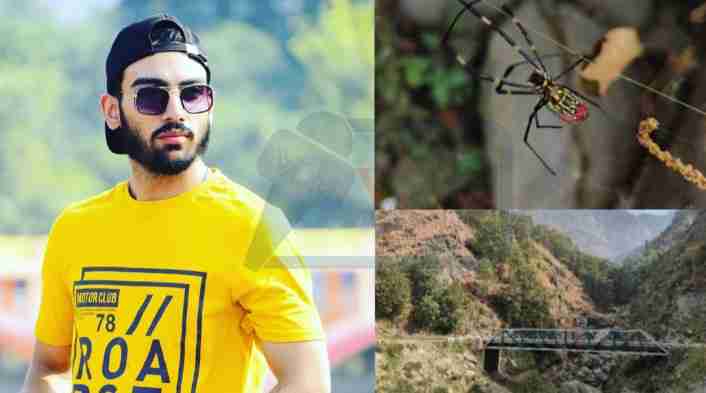
Doda, J&K – July 2025: In a surprising turn of events, researchers have documented the first-ever sighting of the Joro Spider (Trichonephila clavata) in Jammu and Kashmir, raising questions/concerns and revealing the details about the species’ expanding ecological range and adaptability to colder climates.
The sighting occurred in Goha Tehsil, located in the Doda district, at an altitude of over 1,550 meters. The bright-colored spiders were observed building large, intricate webs along a roadside bridge and adjacent vegetation — a setting far removed from their native habitats in East Asia, where the species is typically found in warmer and more humid environments.
The discovery was made by Saqib Masood Salaria, a young researcher from Dev Bhoomi Uttarakhand University, and currently working as a contractual Lecturer, at GHSS Behota, Marmat _ who initially noticed the spiders’ unusual coloration and large web structures during a field visit in October 2024.
The observations were confirmed through the iNaturalist platform, where entomologists identified the spiders as Trichonephila clavata.
Further confirmation came from Dr. Andrew K. Davis, an ecologist at the University of Georgia (USA) and a leading authority on Joro spiders, who validated the species identification based on field images.
Traditionally known to inhabit countries like Japan, China, and Korea, the Joro Spider has only recently begun spreading into new territories, including parts of the southeastern United States. Its appearance in Jammu and Kashmir represents the northernmost known distribution of the species in South Asia.
Despite the cooler temperatures in the region — averaging 15–20°C in October and November — the spiders appeared to thrive.
AI in finance: Which countries are ahead?
Field studies suggest that T. clavata may possess physiological adaptations such as a higher heart rate in colder conditions, allowing it to survive and reproduce beyond its usual climatic zone.
“No previous record of Joro spiders exists for Jammu and Kashmir,” Salaria told VoM News. “After comparing with regional spider checklists and seeking expert confirmation, we believe this is the first scientific documentation of the species in this part of India.”
The field team noted that the spiders, particularly females, built large orb webs between bridge railings and roadside vegetation, often within 5–10 meters of motorways. Their presence along areas with moderate vehicular traffic suggests a growing tolerance to human activity.
Consistent with earlier research from Georgia (USA), the spiders displayed a startle-freezing response — remaining motionless for extended periods after disturbances. This behaviour, experts suggest, may contribute to their ability to coexist in semi-urban or human-modified environments.
While the arrival of the Joro spider in Jammu and Kashmir adds to the region’s biodiversity, it also raises concerns about the potential ecological impact of an invasive predator.
Researchers warn that the spiders may disrupt local food chains, outcompete native spiders, and negatively affect populations of pollinating insects such as bees. These risks underscore the need for further investigation into how the species integrates into — or alters — its new environment.
Ananda in the Himalayas Launches New Integrated Diabetes Management Program
“No spiders were found at higher altitudes where temperatures drop significantly,” Salaria said, indicating that while the species is extending its range, its cold tolerance may still have limits.
Adaptation of Joro Spider
The appearance of T. clavata in colder areas may also reflect broader climate-related shifts in species distribution. “This observation supports existing studies that show invasive species adapting quickly to new environmental pressures — a pattern seen globally as climate zones shift,” said Swati Gupta, co-author of the study.
The findings echo a growing body of research linking biological invasions with climate change and global trade — two powerful forces influencing ecological dynamics across continents.
Researchers emphasize the need for long-term monitoring, public awareness, and ecological assessments to determine the impact of the Joro spider’s presence in the Himalayan foothills.
“Whether this is a one-off introduction or the beginning of a new invasive trend is something only time and careful observation will reveal,” Gupta added.
As science continues to track invasive species and their surprising adaptability, the appearance of the Joro spider in Jammu and Kashmir serves as both a discovery and a warning — that even the remotest regions are not immune to global ecological changes.
About the Author

Dil Bar Irshad is an Indian journalist, writer, and media entrepreneur from the Marmat area of Doda in Jammu and Kashmir, India. He is best known as the founder and Editor-in-Chief of VoM News ("Voice of Masses"), a digital news portal dedicated to highlighting public grievances and citizen issues.Career Overview• Early Career (2015–2016): He began his reporting career focusing on local public issues and citizen grievances in Jammu and Kashmir. • Regional & National Journalism: Over the years, he served as a District Correspondent for the English newspaper Khalsa Express News (2019–2020) and worked as an Urdu correspondent for Sada e Kohistan. He also reported as a J&K Correspondent for the Millennium Post. • International Reporting: In 2023, he expanded into international journalism, working as an India Correspondent for global agencies like BNN Breaking and later TrimFeed, covering diverse topics ranging from stock market updates to regional and global geopolitical developments. • Media Associations: He is an active member of the All India Media Association.Seen IN: Editor-in-Chief, VoM News India, Jammu and Kashmīr Business and Finance, Crime and Justice, Environment As seen in: VoM News, MSN, MSN India, MSN Singapore, MSN UK, Youth Ki Awaaz, Millennium Post, AgroPages, The California Courier, Hecho En California, Justice News, The Chenab Times, Niguro, Sisnoo
Latest Posts
- BREAKING: France Protests 2026; Night Curfews Imposed in Four Cities After Violent Protests19 Oct 2026
- BREAKING: GREF Porter Killed, 3 Critically Injured in Poonch Landslide19 Oct 2026
- Indian Embassy in Italy Issues Advisory Amid Protests, Urges Nationals to Avoid Crowded Areas19 Oct 2026
- Control Resonant Sells 1 Million Copies in Three Weeks, Becomes Remedy’s Fastest-Selling Game19 Oct 2026
- CJP Leaders Ashutosh Ranka, Saurav Das Remain in Tihar as Judicial Custody Extended by Two Days19 Oct 2026
- Delhi Police Files Chargesheet Against 7 In Death Case of Manipur Musician Chongtham Vikram Singh19 Oct 2026
- WCS Welcomes New IUCN Report Calling for Ecological Integrity to Be at the Heart of Global Conservation Efforts19 Oct 2026
- Jersey City Police Make 27 Gun-Related Arrests Since September19 Oct 2026
- Stone Thrown at Srinagar-Bound Passenger Bus in Ludhiana, Punjab; Police Launch Probe19 Oct 2026
- Around 2.7 Lakh Students to Appear in JKBOSE Class 10, 11 and 12 Exams19 Oct 2026