
Janu-worry scams spike: Gen Z and Millennial Brits most likely to fall for investment fraud, survey reveals
January is peak season for scammers. As households face mounting financial pressure after the holidays, fraudsters are preying on this desperation, luring people with promises of quick profits. Alarmingly, Brits have lost an eye-watering £97.7 million to investment scams in just six months, contributing to a staggering £629 million in fraud losses in the first half of 2025.
At the same time, Gen Z and Millennials are entering the investment world at record rates, now making up nearly a third of all UK investors.
As part of their fraud-fighting initiatives, the forex broker experts at BrokerChooser surveyed a representative panel of 2,000 adults and asked how they would respond in 4 different scam scenarios. Alarmingly, around 9 in 10 people (91%) said they would act in a way that could expose them to fraud.
Key findings:
- Nearly one in three (30.95%) Brits lack confidence in spotting investment scams.
- Young adults (25-34) are most likely to overestimate their confidence in spotting an investment scam, with many still willing to engage with suspicious platforms.
- Millennials (26.53%) and Gen Zs (20.21%) are over six times more likely than Boomers (3%) to say they’d test a suspicious trading platform with a small amount.
- One in six Gen Zs (15.03%) would invest in a suspicious forex opportunity based on celebrity or influencer endorsements, while almost one in five (19.95%) say screenshots of profitable trades would persuade them.
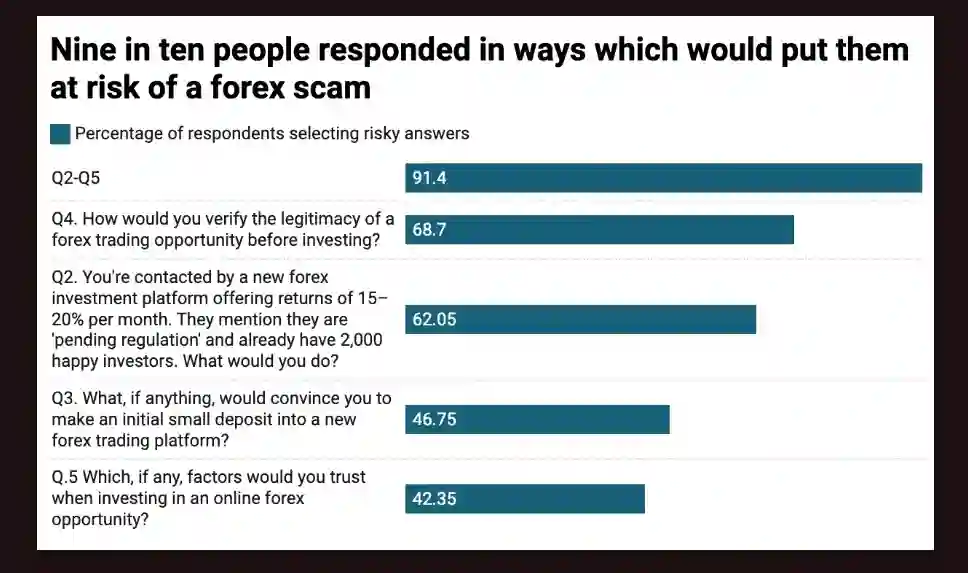
Shockingly, nine in ten respondents (91%) overall said they would act in a way that could expose them to fraud. Question 4: ”How would you verify the legitimacy of a forex trading opportunity before investing?” had the highest proportion of respondents selecting risky answers, with almost one in four (23.15%) saying that they would ask the broker directly for copies of their licenses and certificates.
This is a risky approach, as it relies entirely on trusting the word of the broker, who may provide forged or misleading documentation. Scammers often exploit this tactic by creating convincing fake credentials to appear legitimate, making direct engagement a potential trap rather than a form of due diligence.
Q1. How confident do you feel in your ability to spot an investment scam?

New insights from the forex broker experts at BrokerChooser found that one in three (30.95%) people lack confidence in their ability to spot an investment scam, with those aged 45 to 54 (38.8%) reporting the highest uncertainty.
On the other hand, three in five people feel confident overall in their ability to identify an investment scam (60.20%), yet only 16.8% consider themselves ‘very confident’. This figure plummets to just 8.67% among over-55s, highlighting their risk.
More than three-quarters of young adults feel confident that they could spot an investment scam, but is this ability overestimated?
Meanwhile, young adults aged 25 to 34 appear to be the most self-assured, with over three-quarters (76.22%) feeling confident, and one in three (32.62%) rating themselves as ‘very confident’. But crucially, are people overestimating their ability to spot investment scams – and leaving themselves more vulnerable as a result?
Q2. You’re contacted by a new forex investment platform offering returns of 15–20% per month. They mention they are ‘pending regulation’ and already have 2,000 investors. What would you do?
Despite being the most confident in their scam-spotting abilities, those aged 25 to 34 were the most likely to turn to friends or family to check if they’ve heard of the platform or knew anyone who had invested (35.67%). This is a form of social proof that scammers often exploit, as friends and family can be just as misled, especially when early returns appear convincing.
Besides, Millennials (26.53%) and Gen Zs (20.21%) are the most likely to say they’d test the platform with a small amount, unknowingly exposing themselves to greater risk – compared to just 3% of Boomers. A classic scam tactic, scammers often fabricate early successes to lure people into making bigger investments later.
Interestingly, the survey from the forex broker experts at BrokerChooser found that women are more risk-aware than men when it comes to forex opportunities, with just 10% saying they’d test a small deposit in a forex opportunity, compared to 17% of men.
Q3. What would convince you to make an initial small deposit into a new forex trading platform?
Almost one in five (19.96%) Gen Z respondents say they’d be convinced to invest in a new forex platform based on screenshots of profitable trades. This is concerning given that two out of three forex customers typically lose money and the fact that 50% of fraud now involves the use of AI, which can be used to fake images. This tactic continues to sway younger, visually-oriented investors.
Even more concerning, over a third of 25 to 34-year-olds (35.37%) – and nearly a quarter of 35 to 44-year-olds (23.68%) – say they’d trust testimonials from “other successful traders”. This is a fraudulent tactic commonly used in scams through fake or paid endorsements to create a false sense of credibility.
In contrast, baby boomers appear more cautious, with just 6.55% trusting such testimonials, and only 12.66% saying a money-back guarantee would persuade them to invest. While that may sound reassuring, such promises only carry weight if backed by regulation and legal accountability.
Krisztián Gátonyi, from BrokerChooser, commented on the rise of investment scams:
“A quarter of young investors admit to making impulsive decisions in order to keep up with current investment trends, often leaving little time to properly evaluate the risks. Amid a sharp rise in investment scams, this behaviour is particularly dangerous – especially as fraudsters grow increasingly sophisticated in how they present themselves.
With the rise of AI, we’re now seeing realistic fake websites, chatbot ‘advisors’, and even deep fake videos of celebrities endorsing bogus schemes. It’s becoming harder for even seasoned investors to separate genuine opportunities from high-tech fraud. A concerning new study reveals that participants were 22% more likely to invest in AI-enhanced scams than in traditional ones.7
While younger adults tend to feel more sure of themselves, some are still falling for red flags like promises of unrealistic returns, unregulated platforms claiming to be ‘pending approval’, or pressure to act fast. It’s critical that people learn to pause and verify – checking for official registration with financial regulators and scrutinising contact information. AI may be empowering scammers, but regulation and public education to be vigilant are still our best defence.”
About the Author

VoM News Desk -is an online web portal in jammu Kashmir offers regional, National & global news.
Latest Posts
- Direct talks between the Arab and Iranian leadership is essential: International Mediator Faisal Muhammed23 Oct 2026
- Elan Group Brings Festive Cheer to Gurugram with ‘Diwali, The Wonder of Light’, Featuring a Series of Celebrations and Experiences23 Oct 2026
- Punjab Assembly Passes Resolution on Voting Rights Ahead of 2027 Polls, Finance Minister Punjab Harpal Singh Cheema Moves Resolution23 Oct 2026
- J&K Anti-Corruption Bureau Registers Disproportionate Assets Case Against Girdawar Mohd Iqbal Posted at Gandoh in Doda District23 Oct 2026
- Critical ‘PHP2Shell’ Flaws Put Millions of Websites at Risk, CERT-India Urges Urgent Update23 Oct 2026
- Bhutan Opens New Gelephu Immigration Terminal With Biometric E-Gates for Indian Travellers23 Oct 2026
- IndiGo Saudi Arabia Flights Suspended Amid Drone and Missile Attacks by Yemen’s Iran-Backed Houthis23 Oct 2026
- India Reminds Pakistan of Not Accepting its Soldiers Killed During 1999 Kargil conflict; Cites Minority Rights23 Oct 2026
- New Zealand Military Chief Tony Davies Resigns Over Undisclosed Inappropriate Relationship23 Oct 2026
- All 14 Indian Nationals Aboard Yacht Off Yemen Coast Reported Safe: Indian Embassy in Yemen23 Oct 2026