
 Follow on Google News
New Study Maps Jaguar Corridors Across the Americas, Reveals Previously Unknown Wildlife Routes From Mexico to Argentina
GPS Tracking Reveals New Pathways Connecting Jaguar Populations—and Warns Some Historic Connections May Be Fading …. READ MORE STORY
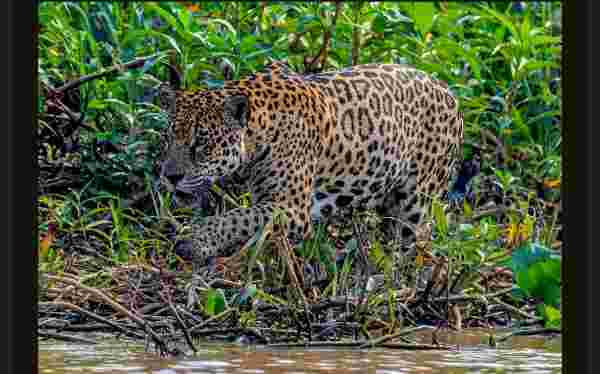
BRONX, NY, (October 15, 2026) — A new study published in the journal Ecosphere has produced a comprehensive map of how jaguars move across the Americas, identifying previously unrecognized wildlife corridors connecting populations from Mexico to Argentina while suggesting that some historically important connections may already have been lost.
The study, led by WCS conservationist Harshad Karandikar and an international team of researchers, analyzed more than 134,000 GPS locations collected from 99 adult jaguars across five countries. The resulting analysis represents the first range-wide assessment of jaguar connectivity based on actual jaguar movement data rather than expert opinion alone.
The findings provide an important new roadmap for conserving Panthera onca, the largest cat in the Americas. By identifying landscapes that facilitate movement between key jaguar populations, the study offers guidance for governments, conservation organizations, Indigenous Peoples, local communities, and land managers seeking to maintain ecological connectivity across one of the world’s most biologically diverse regions.
“Connectivity is fundamental to the long-term survival of jaguars,” said Harshad Karandikar, lead author of the study and a WCS conservationist. “Using GPS movement data from jaguars across their range allowed us to identify areas that are most likely to support movement between populations. Some of the corridors we identified align with previous conservation priorities, while others suggest new opportunities to maintain connectivity before it is lost.”
Habitat loss, fragmentation, infrastructure development, and conflict with people have contributed to jaguars disappearing from more than half of their historic range over the last century. Scientists increasingly view connectivity as essential for maintaining genetic diversity, supporting dispersal, enabling recolonization of suitable habitat, and helping wildlife adapt to environmental change.
“Connectivity maps show us where jaguars can move and what barriers may stand in their way, but the real test is what happens on the ground,” said Dr. Robin Naidoo, study co-author and Lead Scientist at WWF-US. “By combining range-wide mapping with field research, we can see which corridors are being used, where connections are breaking down, and where restoring habitat could help put those connections back together.”
The study identified major connectivity zones across Central America, the Amazon Basin, and southern South America. Among the most significant findings was the identification of a corridor extending from northern Bolivia through the Pantanal and Paraguay River region into Paraguay and northern Argentina. The research also highlighted new potential connections in parts of Central America and revealed areas where previous corridor hypotheses may no longer reflect current landscape conditions.
Panthera Jaguar Program Director Dr. Allison Devlin stated, “This study provides an updated map of potential range-wide jaguar connectivity, forming a future-forward blueprint for the species’ conservation efforts. Taking the lead of the jaguar by using data collected from GPS collars, we used jaguar movement to model potential population connectivity throughout jaguar range. Encouragingly, this research highlights the importance of connections like the Bi-National Corridor in Honduras and Guatemala, the Amazon-Pantanal Corridor in Brazil where Panthera works, and key areas to ground-truth—including Colombia’s A2O Corridor—that warrant greater conservation efforts. Ever informing our science and partnerships, the jaguar guides the way.”
The study arrives at a time when climate change and accelerating habitat conversion are placing increasing pressure on wildlife movement corridors throughout the Americas. Connected ecosystems can help species respond to shifting environmental conditions and may play an important role in maintaining biodiversity, ecosystem resilience, and the ecological integrity of large landscapes.
“Jaguars are telling us something important about the condition of the landscapes they inhabit,” said Luke Hunter, Executive Director of WCS’s Big Cats Program. “When connectivity is lost, populations become isolated and more vulnerable to decline. Protecting corridors is not just about conserving jaguars—it is about maintaining the ecological processes that sustain entire ecosystems across the Americas.”
Researchers note that the newly identified corridors should be viewed as conservation priorities requiring additional field validation through camera trapping, genetic analyses, environmental DNA surveys, and local ecological knowledge. Nevertheless, the study provides one of the clearest pictures yet of how jaguars may move between important habitats across their range.
The findings are expected to inform international conservation initiatives aimed at securing and reconnecting jaguar populations throughout the species’ range. The authors note that many of the identified corridors occur outside protected areas, underscoring the need for conservation approaches that include sustainable land-use planning, restoration efforts, and other effective area-based conservation measures.
Wildlife Conservation Society (WCS)
WCS saves wildlife and wild places worldwide through science, conservation action, education, and inspiring people to value nature. To achieve our mission, WCS, based at the Bronx Zoo, harnesses the power of its Global Conservation Program in more than 55 countries and in all the world’s oceans, and its five wildlife parks in New York City, visited by more than 3.5 million people annually. WCS combines its expertise in the field, zoos, and aquarium to achieve its conservation mission.

VoM News Desk -is an online web portal in jammu Kashmir offers regional, National & global news.
Latest Posts
- Jersey City Free Public Library Partners With Jersey City Police Department for ‘Books & Badges’ Reading and Discussion Series
15 Oct 2026 | Press Release - CHIEF 2026 Announces Speaker Lineup Focused ON Strengthening Caribbean Hospitality Businesses
15 Oct 2026 | Press Release - Black Sea Ship Fire Leaves Seven Crew Members Missing Amid Suspected Russian Drone Attacks Near Romania, Bulgaria
15 Oct 2026 | Breaking News, World - India Questions UN Human Rights Body Over Actions in Pakistan-Occupied Kashmir
15 Oct 2026 | Breaking News, India, World - Pakistan School Roof Collapse: At Least 34 Children, Teacher Killed in Peshawar, Police Say
15 Oct 2026 | Breaking News, Pakistan News, World - Delhi High Court Refuses to Stop CJP’s October 16 Protest at Connaught Place Central Park
15 Oct 2026 | Breaking News, India, Politics - Actor Imran Khan to Challenge FRRO’s Leave India Order in Bombay High Court
15 Oct 2026 | Breaking News, Entertainment - 4 Killed In Explosion At Dye Factory In Gandhinagar, Gujarat
15 Oct 2026 | Breaking News, India - Kishtwar’s SPO Goes Missing With Service Rifle, Search Operation Launched
15 Oct 2026 | Breaking News, Jammu Kashmir - Filipino Couple Mohammed and Aisha Inspire People to Embrace Islam | What They Said ?
15 Oct 2026 | Featured by VoM, Featured Edition