
Research Center for Materials Nanoarchitectonics (MANA) Reveals Atomic-Scale Rails for Guiding Superconducting Vortices
Atomic steps steer vortex motion in ultrathin superconductors, enabling tunable one-dimensional flow
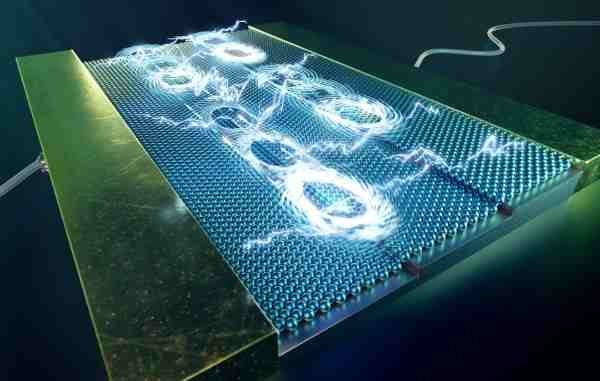
TSUKUBA, Japan, September,25, 2026 /Kyodo JBN/ –Researchers at the Research Center for Materials Nanoarchitectonics (MANA), one of the centers under the National Institute for Materials Science (NIMS), Japan, discovered that atomic-scale steps can guide superconducting vortices in an ultrathin superconductor. Vortices moved more than 1,000 times more easily along the steps than across them, and this guiding effect could be tuned by temperature and magnetic field.
Superconducting vortices are tiny quantum objects whose movement can strongly influence how superconductors behave. Controlling their direction of motion could therefore be important for developing ultralow-power superconducting technologies. However, directional control of vortices in two-dimensional superconductors has remained challenging. Achieving such control could help develop future superconducting devices that consume less power while improving processing efficiency.
Addressing this challenge, a research team led by Takashi Uchihashi from Research Center for Materials Nanoarchitectonics (MANA), National Institute for Materials Science, Japan, investigated an ultrathin superconductor with regularly arranged atomic steps on its surface. Scanning tunneling microscopy confirmed the parallel steps and directly visualized vortices located along them. Their findings were published in the journal Physical Review B on July 30, 2026.
Four-terminal resistance measurements revealed that vortices moved more than 1,000 times more easily along the atomic steps than across them at intermediate magnetic fields. “Our study shows that atomic-scale steps can act as effective rails that guide superconducting vortices, and that this guiding effect can be tuned simply by changing the temperature or magnetic field,” said Uchihashi. Between about 0.10 and 0.20 T, vortices flowed freely along the steps without being hindered by pinning, forming one-dimensional pinning-free vortex flow, while at the lowest temperatures their motion was governed by quantum tunneling.
Overall, the findings demonstrate that one-atom-high surface steps can act as effective rails for guiding quantum vortices, opening possibilities for controlling vortex motion and heat flow in future superconducting technologies.
About the Author

VoM News Desk -is an online web portal in jammu Kashmir offers regional, National & global news.
Latest Posts
- Omar Abdullah Inaugurates ₹26 Crore Development Projects in Beerwah24 Oct 2026
- Direct talks between the Arab and Iranian leadership is essential: International Mediator Faisal Muhammed23 Oct 2026
- Elan Group Brings Festive Cheer to Gurugram with ‘Diwali, The Wonder of Light’, Featuring a Series of Celebrations and Experiences23 Oct 2026
- Punjab Assembly Passes Resolution on Voting Rights Ahead of 2027 Polls, Finance Minister Punjab Harpal Singh Cheema Moves Resolution23 Oct 2026
- J&K Anti-Corruption Bureau Registers Disproportionate Assets Case Against Girdawar Mohd Iqbal Posted at Gandoh in Doda District23 Oct 2026
- Critical ‘PHP2Shell’ Flaws Put Millions of Websites at Risk, CERT-India Urges Urgent Update23 Oct 2026
- Bhutan Opens New Gelephu Immigration Terminal With Biometric E-Gates for Indian Travellers23 Oct 2026
- IndiGo Saudi Arabia Flights Suspended Amid Drone and Missile Attacks by Yemen’s Iran-Backed Houthis23 Oct 2026
- India Reminds Pakistan of Not Accepting its Soldiers Killed During 1999 Kargil conflict; Cites Minority Rights23 Oct 2026
- New Zealand Military Chief Tony Davies Resigns Over Undisclosed Inappropriate Relationship23 Oct 2026