 Follow on Google News
Israel-Iran War LIVE Updates 07 March -2026: Iran Strikes Kurdish Opposition Bases in Iraq as Regional Tensions Escalate
Iran launched missile attacks on positions linked to Kurdish opposition groups in northern Iraq’s semi-autonomous Kurdistan region, according to reports from Iranian state television. The strikes targeted sites Tehran says are used by armed groups it labels “anti-Iran separatists” operating from across the border.
Iranian officials have long accused several Kurdish factions of using bases in Iraq’s Kurdistan region to carry out activities against the Iranian state. The latest attacks come at a particularly tense moment, as reports circulate that the United States may be coordinating with Kurdish opposition groups in Iraq. Some of those factions have signalled they could enter the wider confrontation involving Iran.
Israeli military claims strike on senior Iranian commander
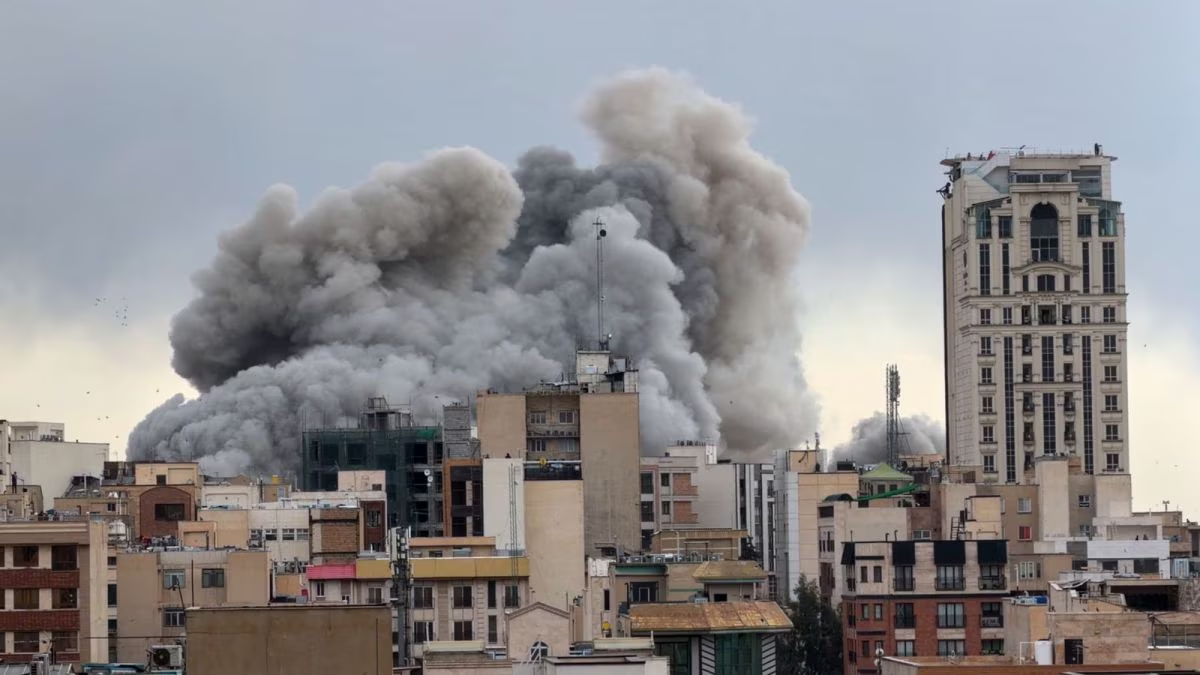
As the conflict widens, the Israeli military says it carried out a strike in the Iranian capital, Tehran, targeting a senior Iranian commander. Israeli officials have not publicly identified the individual they claim to have hit.
Details about the operation remain limited, and Iranian authorities have not confirmed the claim. Still, the announcement suggests the conflict’s battlefield may be expanding deeper into Iranian territory.
Kurdish opposition site reportedly hit in Iraq
Further reports from northern Iraq indicate that one of the targeted locations belonged to the Iranian Kurdistan Democratic Party, an opposition group operating in exile.
According to a correspondent from Al Jazeera, the site was struck by a combination of missiles and drones. Witnesses reported seeing thick plumes of smoke rising from the area shortly after the attack.
So far, there have been no confirmed reports of casualties.
Iran accuses US and Israel of attacks on schools
Meanwhile, Iran’s education minister has appealed to UNICEF to condemn what he described as attacks on schools and education facilities across the country.
In a letter to the UN agency, Education Minister Alireza Kazemi alleged that strikes by the United States and Israel had hit residential neighbourhoods, healthcare centres and educational institutions.
Kazemi said students and teachers had been killed or wounded in several provinces, including Minab, Fars, Ilam, East Azerbaijan, Tehran and Qazvin, as well as districts surrounding the capital.
He added that roughly 20 education centres had suffered severe damage, with some destroyed entirely. The disruption has forced thousands of students out of classrooms.
Earlier figures from UNICEF suggested nearly 200 children across the Middle East have been killed since the latest escalation began.
Israeli soldiers wounded near Lebanese border
Violence has also intensified along Israel’s northern frontier. The Israeli military said eight soldiers were injured after an anti-tank missile struck near the Lebanese border.
Five members of the Givati Brigade were seriously wounded in the attack, while three others sustained lighter injuries and were taken to hospital.
The incident underscores the growing risk of the conflict spreading beyond its initial flashpoints.
Global markets react to widening conflict
The economic impact of the war is already being felt well beyond the battlefield.
According to reporting by The New York Times, financial markets have grown increasingly volatile as investors react to the escalating confrontation with Iran.
The S&P 500 fell 1.3 percent on Friday, pushing its weekly decline to around 2 percent — the index’s worst performance so far in 2026.
Oil markets have moved sharply in the opposite direction. The global benchmark Brent crude climbed to about $92 per barrel, marking an almost 30 percent jump in just one week. Analysts say it’s the biggest weekly surge since the market turmoil triggered by the COVID-19 pandemic in April 2020.
Economic pressure in the United States has also intensified. Data released by the United States Department of Labor showed an unexpected loss of more than 90,000 jobs in February, complicating the outlook for the country’s central bank.
The situation leaves the Federal Reserve facing a difficult choice — whether to lower interest rates to support growth or keep them steady as rising oil prices threaten to fuel inflation.
The issue has already become politically charged. Donald Trump has repeatedly criticised Federal Reserve Chair Jerome Powell over interest-rate policy and earlier this year nominated a preferred candidate to eventually replace him.
Casualties mount as conflict deepens
The humanitarian toll continues to rise across the region.
The Iranian Red Crescent Society says at least 1,332 people in Iran have been killed since US and Israeli strikes began earlier in the week.
Iran’s powerful Islamic Revolutionary Guard Corps (IRGC) announced it had launched its 23rd wave of retaliatory attacks, while Israeli officials said their air-defence systems were intercepting incoming missiles fired from Iran.
In Washington, President Donald Trump insisted that any agreement with Tehran must end with what he described as Iran’s “unconditional surrender”, signalling a hard-line stance from the United States.
Israel, meanwhile, said its forces struck more than 400 targets inside Iran in a single day. According to the Israeli military, those targets included ballistic missile launchers and facilities used to store unmanned aerial vehicles.
White House press secretary Karoline Leavitt said the United States believes it is steadily gaining control of Iranian airspace and expects its key military objectives could be achieved within four to six weeks.
Regional and humanitarian fallout grows
Energy markets and humanitarian groups are warning of broader consequences.
Saad al‑Kaabi, Qatar’s energy minister, cautioned that the conflict could destabilise global economies if it drags on. Major Gulf energy producers, he warned, might be forced to halt production within weeks under worsening security conditions.
Aid agencies are already seeing the impact on civilians. The Norwegian Refugee Council estimates that roughly 300,000 people have been displaced in less than 100 hours after Israeli air strikes intensified across Lebanon, including the capital Beirut.
The Lebanese group Hezbollah said it fired rockets toward two locations in northern Israel in response to the strikes.
Lebanon’s Health Ministry reported that Israeli attacks in the country since Monday have killed at least 217 people and wounded another 798.
As the conflict spreads across multiple fronts, diplomats and analysts warn that the risk of a wider regional war continues to grow.
Welcome to VoM News.We are here with today’s live coverage of Iran-US War. Stay Connected for live updates.
5 updatesUS Has Bombed at Least 10 Countries Since 9/11 — And the Count Keeps Growing in 2026
The story of America’s military footprint since September 11, 2001, reads like a long, unbroken chapter in a book few wanted to keep writing. What began as a focused response to the deadliest terrorist attack on U.S. soil has stretched across more than two decades, four presidencies, and at least ten countries ....read More
Could Iran-Israel Tensions Drain Patriot Missile Supplies of Ukraine?
As several of Washington’s Middle Eastern allies rely on U.S.-made Patriot air defence systems to intercept Iranian missiles and drones, Ukraine may soon face a critical shortage of the same interceptors that have shielded its cities from Russian strikes ....Read more
Latest Updates — VoM News
Azerbaijan says it has foiled alleged “terrorist plans” linked to the Islamic Revolutionary Guard Corps that targeted a major pipeline and Israeli-linked sites.
In the Gulf, Saudi Arabia said its air defence forces destroyed an incoming ballistic missile as regional tensions continue to escalate.
Meanwhile, Israel has launched what officials describe as “broad-scale” air strikes on the Iranian capital, Tehran, as fighting between Iran and the US-Israeli alliance intensifies.
Donald Trump is also expected to attend the return ceremony for the remains of six US soldiers killed in an Iranian attack on Kuwait.
Missile alerts have continued across Israel, with warnings reported near Beersheba in the south and areas in northern Israel. Reporting from Amman, journalist Rory Challands said Iran appears to be maintaining sustained attacks in what analysts describe as an effort to deplete Israel’s missile-interceptor systems.
At the same time, global markets remain on edge. Oil prices have surged amid fears that the expanding conflict and potential disruption in Gulf shipping routes could severely affect global energy supplies.
Your are here on VoM News For Live Updates— Let’s look at what has happened so far:
Explosions were reported across several parts of Iran overnight, including the capital, Tehran, as the war entered its eighth day.
Donald Trump has demanded an “unconditional surrender” from Iran, saying there will be no agreement to end the conflict without it.
The United States Central Command said more than 3,000 targets have been struck in Iran this week, claiming that 43 Iranian warships have been destroyed.
Iran’s ambassador to the United Nations, Amir-Saeid Iravani, told the United Nations Security Council that the US and Israel are bombing civilian areas, calling the attacks “clear war crimes and crimes against humanity.”
UN experts have urged an independent investigation into an attack on a girls’ school in Iran that killed 165 students earlier this week, with reports suggesting the US military may have been responsible.
Qatar Civil Aviation Authority said it will resume limited air traffic through emergency routes for evacuation and cargo flights.
Meanwhile, the White House Press Secretary Karoline Leavitt said the US is moving toward controlling Iranian airspace and aims to establish full control within six weeks.
In Lebanon, the state-run National News Agency reported that recent Israeli strikes in eastern Lebanon killed four people and injured 13 others.
Welcome to VoM News — worrying signs emerge as oil prices spike over fears of a prolonged conflict.
Oil prices surged sharply amid growing fears that the escalating conflict between Iran, the United States and Israel could disrupt global energy supplies. The international benchmark Brent North Sea crude climbed to $92.69 per barrel, rising 8.5 percent in a single day and nearly 30 percent over the past week.
Markets are closely watching the Strait of Hormuz, a critical shipping route through which about 20 percent of the world’s oil supply passes. Iran has repeatedly threatened to close the strategic waterway as tensions in the Gulf continue to escalate.

Latest Posts
- Could Iran-Israel Tensions Drain Patriot Missile Supplies of Ukraine?
March 6, 2026 | Featured by VoM, Politics, World - Nepal Elections 2026: Balen Shah’s Party Heads for Landslide Victory After Gen Z Protests Oust Oli Government
March 6, 2026 | Breaking News, Politics, World - Meet Brigadier General Ahmad Vahidi – the IRGC New Commander Leading amid US‑Israeli War
March 6, 2026 | Politics, World - United States Grants 30-Day Waiver for Indian Purchases of Russian Oil Amid Middle East Conflict
March 6, 2026 | Breaking News, India, Politics - President Donald Trump Urges Iranian Forces to Surrender or Face ‘Guaranteed Death’
March 6, 2026 | Breaking News, Politics, World - Over 2,000 Drones Launched by Iran — and Why Does FM Abbas Araghchi Araghchi Say Plan A Failed and Plan B Will Fail Too?
March 6, 2026 | Breaking News, Politics, World - Iran US-Isreali Conflict LIVE Updates March 06 -2026: Thousands Killed, Major Strikes Across the Middle East
March 6, 2026 | Breaking News, Live Updates, World - India Vs England T20 WorldCup Semi-final 2026 LIVE Updates: India Finishes on 253/7 | Could England Chase !!
March 5, 2026 | Breaking News, Live Updates, Sports - JKBOSE Notifies Syllabi for Classes 9th-12th
March 5, 2026 | Jammu Kashmir - The Human Toll of the US-Israel-Iran Conflict
March 5, 2026 | Featured by VoM, Politics, World