 Follow on Google News
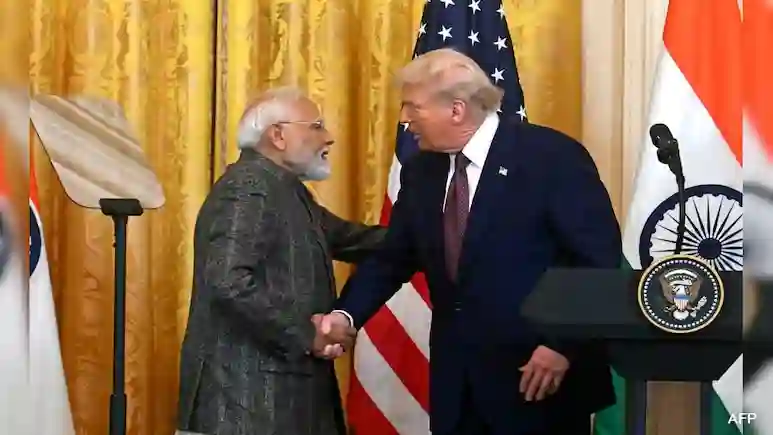
India and the United States have sealed a major trade agreement that will significantly lower tariffs on Indian goods entering the American market, marking a turnaround in bilateral economic ties after months of strain.
Under the deal, Washington will reduce tariffs on Indian exports to 18 per cent, down from as high as 50 per cent, US President Donald Trump announced on Monday following a phone call with Prime Minister Narendra Modi. In return, New Delhi has agreed to halt purchases of Russian oil and move towards lowering trade and non-tariff barriers for US products.
Prime Minister Modi welcomed the announcement, calling it a positive step for Indian industry and exporters. “Delighted that Made in India products will now have a reduced tariff of 18 per cent. Big thanks to President Trump on behalf of the 1.4 billion people of India,” he said in a post on X. He added that cooperation between the world’s largest democracies unlocks “immense opportunities for mutually beneficial growth.”
Relief for exporters, farmers and MSMEs
Commerce and Industry Minister Piyush Goyal described the agreement as a game-changer for domestic stakeholders, particularly farmers, MSMEs, entrepreneurs and skilled workers. He said the deal would strengthen the Make in India initiative and help India access advanced US technology.
“This agreement unlocks unprecedented opportunities to Make in India for the world, Design in India for the world, and Innovate in India for the world,” Goyal said, noting that it reflected the strength of two fair-trading democracies working together.
Commerce Secretary Rajesh Agrawal also termed it a landmark pact, saying it would drive shared prosperity, innovation and long-term growth for both countries.
The announcement comes as labour-intensive sectors such as textiles, apparel, leather, footwear and marine products were grappling with steep US tariffs that had made Indian exports less competitive. Export bodies expect an immediate release of orders that were earlier put on hold, especially for summer-season sourcing.
How India compares globally
With the new tariff rate, India now faces lower duties than several competing Asian economies. Officials pointed out that US tariffs stand at around 20 per cent for Vietnam and Bangladesh, 19 per cent for Pakistan and Malaysia, and 34 per cent for China. However, India’s rate remains slightly higher than that for some developed partners, including the European Union, Japan and South Korea, which face tariffs of about 15 per cent, and the UK at 10 per cent.
The US has imposed much higher tariffs on other countries, including Brazil (50 per cent), Myanmar and Laos (40 per cent each), and South Africa (30 per cent).
Trade flows and market reaction
India’s merchandise exports to the US had dipped in recent months amid higher tariffs, falling 1.83 per cent year-on-year to $6.88 billion in December 2025, according to Commerce Ministry data. Imports from the US, meanwhile, rose 7.57 per cent to $4.03 billion during the same period.
For the April–December window of the current fiscal year, exports to the US still grew 9.75 per cent to $65.87 billion, while imports climbed 12.85 per cent to $39.43 billion.
Markets reacted positively to the deal. Indian equity benchmarks surged at the opening bell on Tuesday, while the rupee strengthened against the US dollar, reflecting optimism over improved trade prospects and potential foreign investment inflows.
What remains unclear
Despite the announcement, several details are yet to be clarified. The US has not issued a formal presidential proclamation or Federal Register notice specifying when the reduced tariffs will take effect. There is also no official timeline for India’s halt of Russian oil purchases or clarity on which products are covered under the agreement.
Indian Markets Surge as India–US Trade Deal Lifts Investor Sentiment
US President Trump said India would “buy American” at a much higher level, including more than $500 billion worth of US energy, technology, agricultural and other products. He also claimed India would move to reduce its tariffs and non-tariff barriers on US goods to zero, though neither side has released a detailed framework.
External Affairs Minister S Jaishankar, currently in Washington for a ministerial meeting on critical minerals supply chains, welcomed the deal, saying it would create jobs, spur innovation and deepen trusted technology ties between the two countries.
As exporters and analysts await the fine print, the agreement is being seen as a significant reset in India–US economic relations, with the potential to reshape trade flows and strengthen a strategic partnership that had come under pressure over the past year.

Latest Posts
- Iran to Get Chinese Missile Systems Within Weeks: Sources
July 30, 2026 | Breaking News, Politics, World - Pull Doda Bridge Declared Safe for Traffic, Subject to Continuous Monitoring: DIQC Report
July 29, 2026 | Breaking News, Doda, Jammu Kashmir - Unilever agrees two-year worker protection after $65 billion McCormick merger, memo shows
July 29, 2026 | Breaking News, Business, Stock Market - Adani Enterprises Posts Quarterly Loss After One-Time OFAC Settlement Charge
July 29, 2026 | Breaking News, Business, India - Asian Paints Beats Q1 Estimates
July 29, 2026 | Breaking News, Business, Stock Market - Former PM Sheikh Hasina Vows Return to Bangladesh by December Despite Arrest, Death Fears
July 29, 2026 | Breaking News, Politics, World - Russia Charges Telegram Founder Pavel Durov With ‘Aiding Terrorism’, Puts Him on Wanted List
July 29, 2026 | Breaking News, Politics, World - US, Saudi Forces Strike Iran-Backed Militias in Iraq as Regional Tensions Escalate
July 29, 2026 | Breaking News, Politics, World - India Condemns Attacks on Ships in Strait of Hormuz at UN Security Council; Calls for Immediate De-escalation
July 29, 2026 | Breaking News, Politics, World - No Evidence of Active Cyberattack on DRDO , Defence Ministry Refutes Reports
July 29, 2026 | Breaking News, Cybersecurity, India