 Follow on Google News
Could Iran-Israel Tensions Drain Patriot Missile Supplies of Ukraine?
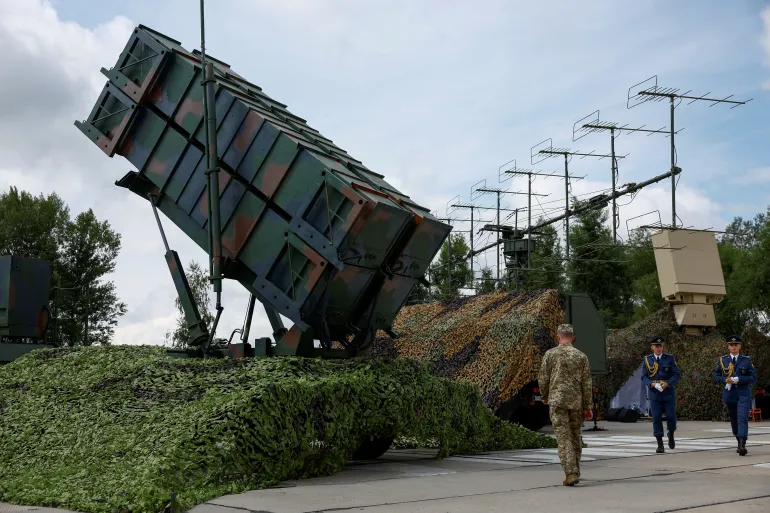
As several of Washington’s Middle Eastern allies rely on U.S.-made Patriot air defence systems to intercept Iranian missiles and drones, Ukraine may soon face a critical shortage of the same interceptors that have shielded its cities from Russian strikes.
As per Al Jazeera Report, Military analysts say the shift in demand could play directly into the hands of Russian President Vladimir Putin. The guided missiles fired by Patriot batteries — launched in rapid succession from truck-mounted launchers — have been one of Ukraine’s most effective tools against Russia’s ballistic missile arsenal.
The Patriots were originally developed in the 1970s to counter Soviet missile threats. Decades later, upgraded versions of those same Soviet-era designs are still being used by Russia in its war against Ukraine.
Key Shield for Kyiv
Ukraine first received Patriot systems in 2023. Initially, only a handful of batteries were deployed, mostly around the capital, Kyiv. Their locations were frequently changed to avoid Russian targeting.
Despite their limited numbers, the systems quickly became a central pillar of Ukraine’s air defence.
“They have undoubtedly been the most important defence element, especially for cities with more than a million residents, Kyiv in particular,” said Nikolay Mitrokhin of University of Bremen. Still, he cautioned that even the Patriots cannot intercept every missile fired at Ukraine.
The looming shortage highlights a deeper vulnerability. Ukraine’s power plants, transmission lines and other vital infrastructure remain exposed to sustained Russian strikes.
Even with additional Patriot missiles, Mitrokhin said, protecting the entire energy network would be nearly impossible. Nuclear power stations may remain off-limits because of the risks involved, but other parts of the grid are far harder to shield.
“The real question,” he said, “is how to stop Russia from producing and launching missiles — not simply how many Patriot interceptors Ukraine receives.”
A Costly Line of Defence
Patriot batteries rely on advanced radar systems capable of detecting supersonic targets. When activated, the launchers fire guided missiles in quick bursts — sometimes as many as 32 in a minute.
For Ukrainians enduring hours-long Russian air raids, the distinctive sound of those launches has often brought a sense of relief. The explosions that follow — brief flashes of blinding light and thunderous shockwaves — signal that incoming missiles have been intercepted.
Soon after their arrival in Ukraine, Patriots successfully shot down Russia’s hypersonic Kinzhal missiles, weapons the Kremlin once described as unstoppable. Those interceptions challenged Putin’s earlier claim that Western air defences were “useless” against the weapon.
But the protection comes at a steep price. Each interceptor costs several million dollars, and global production has historically remained limited — rarely exceeding about 900 units a year.
A Shortage on the Horizon
The strain on supplies is becoming increasingly clear. Ukrainian President Volodymyr Zelenskyy said nearly 800 Patriot missiles were used in just three days to counter Iranian aerial attacks targeting multiple countries in the Middle East.
“Ukraine has never had this many missiles to repel attacks,” Zelenskyy said Thursday, adding that Kyiv was ready to send experts and drone-interception technologies to assist Gulf states facing similar threats.
For now, analysts say the shortage isn’t immediate. But it may not be far away.
“This is not today’s problem. It’s tomorrow’s problem,” said Volodymyr Fesenko, head of Kyiv’s Center for Applied Political Studies (Penta).
Still, the consequences could be severe. In recent days Russia has reduced drone and missile attacks on Ukraine — a pause that some analysts interpret as preparation for a larger offensive.
“Russia’s most obvious move would be to drain Ukraine’s Patriot missile stock and then launch massive missile strikes,” Fesenko said.
Ukraine is already grappling with another challenge: limited supplies of missiles for Western-supplied F‑16 Fighting Falcon fighter jets. While the shortage isn’t as acute, the aircraft have proved useful in intercepting incoming missiles.
A Familiar Problem
Kyiv has faced a similar situation before. Last summer, when the United States and Israel launched strikes on Iranian nuclear sites, the Pentagon temporarily paused shipments of Patriot interceptors while reviewing its own stockpiles.
That interruption left Ukraine’s civilian infrastructure — including thermal power plants and transportation hubs — more vulnerable to Russian attacks.
Russian air raids often follow a calculated pattern. First come waves of drones, including decoys designed to exhaust Ukrainian air defences. Then follow additional waves of drones, cruise missiles and ballistic missiles.
“The next attacks might not focus on energy infrastructure,” said Kyiv-based analyst Igar Tyshkevych. “The Kremlin may choose completely different targets.”
Previous Russian strikes on heating plants and power stations left millions of Ukrainians without electricity during winter, triggering serious health risks and even deaths from hypothermia.
Limited Defences
Ukraine has fewer than a dozen Patriot batteries, while officials say at least 25 would be needed to provide effective nationwide coverage.
According to retired Lieutenant-General Ihor Romanenko, a former senior officer in Ukraine’s military who specialised in air defence, the conflict has become a constant technological contest.
“There is a confrontation in engineering,” Romanenko said. “If you stay on the old technological level, you lose the battle before it even begins.”
Russian engineers, he said, have already upgraded the software guiding their Iskander‑M missile system, allowing the missiles to manoeuvre in mid-air — a modification that complicates interception.
Russia has also adapted its targeting strategy.
“They know we only have a few Patriot batteries,” Romanenko said. “So they strike areas where those systems are not deployed.”
Searching for Alternatives
Ukraine does have limited backup options. A small number of Franco-Italian SAMP/T air defence system batteries have been deployed since 2023.
These systems require far fewer personnel — roughly a dozen operators compared with up to 90 for a Patriot battery — and can be deployed much faster.
Whether they can reliably intercept Russia’s newer missile designs, however, remains uncertain.
Meanwhile, Ukraine has stepped up its own long-range attacks inside Russia. In recent weeks, Ukrainian strikes have reportedly damaged ammunition depots, drone factories and naval assets — including the Russian frigate Admiral Essen, capable of launching Kalibr cruise missiles from the Black Sea.
For Kyiv, the battle in the skies continues to evolve. But as demand for air defence spreads across multiple conflicts, the systems that once protected Ukrainian cities may soon be in far shorter supply.

Latest Posts
- Nepal Elections 2026: Balen Shah’s Party Heads for Landslide Victory After Gen Z Protests Oust Oli Government
March 6, 2026 | Breaking News, Politics, World - Meet Brigadier General Ahmad Vahidi – the IRGC New Commander Leading amid US‑Israeli War
March 6, 2026 | Politics, World - United States Grants 30-Day Waiver for Indian Purchases of Russian Oil Amid Middle East Conflict
March 6, 2026 | Breaking News, India, Politics - President Donald Trump Urges Iranian Forces to Surrender or Face ‘Guaranteed Death’
March 6, 2026 | Breaking News, Politics, World - Over 2,000 Drones Launched by Iran — and Why Does FM Abbas Araghchi Araghchi Say Plan A Failed and Plan B Will Fail Too?
March 6, 2026 | Breaking News, Politics, World - Iran US-Isreali Conflict LIVE Updates March 06 -2026: Thousands Killed, Major Strikes Across the Middle East
March 6, 2026 | Breaking News, Live Updates, World - India Vs England T20 WorldCup Semi-final 2026 LIVE Updates: India Finishes on 253/7 | Could England Chase !!
March 5, 2026 | Breaking News, Live Updates, Sports - JKBOSE Notifies Syllabi for Classes 9th-12th
March 5, 2026 | Jammu Kashmir - The Human Toll of the US-Israel-Iran Conflict
March 5, 2026 | Featured by VoM, Politics, World - US-Israeli Strikes on Iran LIVE Updates March 05, 2026 | Senate Fails To Curb Trump War Powers
March 5, 2026 | Breaking News, Live Updates, Politics, World