
 Follow on Google News
US Bolsters Military Presence in Middle East as Trump Warns Iran, Tehran Says It Is Not Intimidated
The United States has significantly expanded its military footprint in the Middle East amid rising tensions with Iran, as President Donald Trump warned late last month that “very big, very powerful” American ships were sailing toward the region and expressed hope that Washington would not be forced to use them.
As speculation grows over a possible US strike on Iran, Tehran has dismissed the show of force. Iranian Foreign Minister Abbas Araghchi acknowledged on Sunday that the United States was building up its military assets in the region but insisted that Iran was unfazed. “Their military deployment in the region does not scare us,” he said, adding that Iran does not understand “the language of force.”
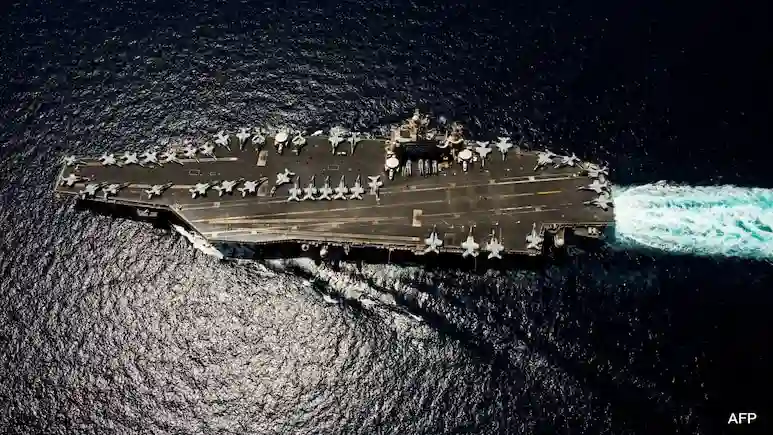
At the end of January, the US Navy deployed its aircraft carrier USS Abraham Lincoln to the Arabian Sea, accompanied by three guided-missile destroyers — USS Frank E. Petersen Jr., USS Michael Murphy, and USS Spruance — as tensions with Iran intensified. The carrier strike group joined three other US Navy destroyers already operating in the region, including two near the strategically vital Strait of Hormuz and another in the Red Sea.
In a visible display of military power, the US military shared images on social media showing the Abraham Lincoln carrier group sailing through the Arabian Sea with fighter aircraft flying overhead, accompanied by the message “Peace through Strength!”
US Military Bases In The Gulf Under Iran’s Ballistic Missile Shadow
Along with the carrier deployment, approximately 5,700 additional US service members have arrived in the region. The US Navy also has three littoral combat ships — USS Santa Barbara, USS Canberra, and USS Tulsa — stationed in the Persian Gulf. These vessels could be tasked with minesweeping operations if Iran were to deploy naval mines in key shipping routes.
US Central Command confirmed that Air Force F-15E Strike Eagle fighter jets are now operating in the Middle East, stating that their presence “enhances combat readiness and promotes regional security and stability.” Reports have also indicated the arrival of additional US air assets, including an MQ-9 Reaper drone, A-10C Thunderbolt II ground-attack aircraft, and more F-15 fighter jets at Muwaffaq Salti Air Base in Jordan.
According to an analysis by the BBC, satellite imagery showed the guided-missile destroyer USS Delbert D. Black transiting the Suez Canal from the Mediterranean Sea into the Red Sea, while a US Navy MQ-4C Triton surveillance drone was seen operating over the Gulf. The presence of other surveillance and reconnaissance platforms, including E-11A communications aircraft, P-8 Poseidon maritime patrol planes, and E-3G Sentry airborne warning and control aircraft, has also been reported in recent weeks.
The United Kingdom has joined the heightened defensive posture. Britain’s Ministry of Defence said last week that it had deployed Typhoon fighter jets to Qatar “in a defensive capacity.”
The US has also reinforced its air defence systems in the region. Additional Terminal High Altitude Area Defence (THAAD) systems and Patriot missile batteries were deployed, including at Al Udeid Air Base in Qatar, where satellite imagery last month confirmed the presence of advanced missile defence equipment.
The current military activity mirrors previous US deployments ahead of anticipated Iranian retaliation. In an earlier episode, Iran launched more than a dozen missiles at Al Udeid Air Base following US strikes on three key Iranian nuclear facilities.
Amid the escalating tensions, Washington has issued new guidance to commercial shipping. On Monday, the US Department of Transportation’s Maritime Administration advised US-flagged vessels transiting the Strait of Hormuz — a critical chokepoint for global oil supplies — to remain as far from Iranian territorial waters as possible. Vessels were also instructed to verbally refuse permission if Iranian forces attempt to board them.
President Trump has repeatedly threatened military action against Iran, demanding that Tehran halt uranium enrichment — which he says could pave the way for nuclear weapons — end its ballistic missile programme, and cease support for armed groups across the region. Iran has consistently denied seeking nuclear weapons, maintaining that its nuclear programme is for peaceful purposes.
As both sides harden their positions, the growing concentration of military assets in the Middle East has heightened concerns about the risk of miscalculation in an already volatile region.

Latest Posts
- Provident Fund Body EPFO Retains 8.25 Percent Interest For 2025-26
March 2, 2026 | Breaking News, India - Oil Prices Jump Up To 12% As Middle East Conflict Sparks Supply Fears
March 2, 2026 | Breaking News, Business, World - US Denies Iranian Strike On USS Abraham Lincoln As UAE Reports Drone Attack
March 1, 2026 | Breaking News, Politics, World - Iran Claims Missile Strike On USS Abraham Lincoln As Leadership Transition Unfolds
March 1, 2026 | Breaking News, Politics, World - Ayatollah Alireza Arafi – The Interim Supreme Leader | Will He Carve Out Iran from Sensitive Phase After the Death of Ali Khamenei
March 1, 2026 | Breaking News, Politics, World - Saudi Prince Mohammed bin Salman Made Multiple Private Calls to Trump Urging Strike on Iran: Washington Report
March 1, 2026 | Breaking News, Politics, World - United Kingdom Maritime Trade Operations (UKMTO) Warns of ‘Significant Military Activity’ Around Strait of Hormuz
March 1, 2026 | Breaking News, Politics, World - Islamic Revolutionary Guard Corps IRGC Vows Relentless Offensive Until ‘Enemy Is Decisively Defeated’
February 28, 2026 | Breaking News, Politics, World - Middle East Tensions Escalate as Iran, Israel, US Exchange Strikes; Gulf States on High Alert
February 28, 2026 | Breaking News, Politics, World - Iran-US War Escalates LIVE Updates: Iran Condemns Cites Right to Self-Defence Under UN Charter
February 28, 2026 | Live Updates, Politics, World