 Follow on Google News
Surge in Global Interest Puts Pakistan’s JF-17 Fighter Program to the Test
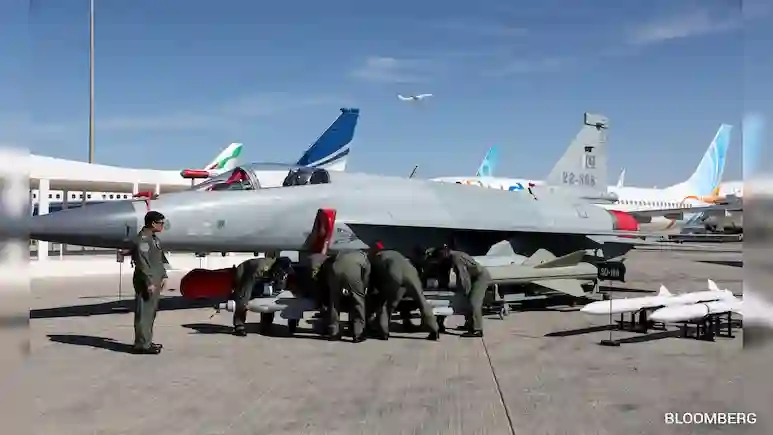
Pakistan’s homegrown JF-17 Thunder fighter jet is drawing unprecedented international attention, with at least five countries showing interest in recent months — a level of demand that could stretch the country’s limited production capacity and reshape its defence export ambitions.
According to Pakistan’s armed forces, Iraq, Bangladesh and Indonesia have formally expressed interest in the aircraft over the past month. Saudi Arabia and Libya are also exploring potential purchases, Reuters has reported. The uptick follows Islamabad’s claims that Chinese-origin jets, including the JF-17, performed strongly during the brief but intense conflict with India in May 2025.
For now, Pakistan produces fewer than 20 JF-17s a year, most of which are inducted directly into its own air force. Whether that output can be scaled up quickly remains an open question — and a crucial one. Export success would mark a major step for Pakistan’s defence industry and simultaneously bolster China’s reach in the global arms market.
Analysts say the jet’s growing appeal is driven by a combination of price and perceived battlefield credibility. Manoj Harjani, a research fellow at Singapore’s S Rajaratnam School of International Studies, described the JF-17 as a potential disruptor.
“It’s competitively priced, and recent combat exposure has given it visibility,” Harjani observed. “For air forces that can’t afford Western fighters, it’s an attractive option.”
A shift away from Western suppliers would be significant, particularly for countries like Indonesia and Saudi Arabia. Jakarta has recently inducted Dassault Rafale jets under a deal with France and agreed in 2023 to buy 24 F-15s from Boeing. Saudi Arabia, meanwhile, relies heavily on US and European aircraft and has long sought access to the F-35.
A fighter built to compete on cost
The JF-17 traces its origins to a 1999 agreement between Pakistan and China. It is jointly produced by the Pakistan Aeronautical Complex in Kamra and China’s AVIC Chengdu Aircraft Company. Former Air Commodore Khalid Chishti has said Pakistan currently manufactures between 16 and 18 aircraft annually.
Cost remains the jet’s biggest selling point. Defence Production Minister Raza Hayat Harraj told BBC Urdu last month that a JF-17 typically costs between $40 million and $50 million, depending on the variant and customisation. Comparable Western fighters, such as advanced versions of the Rafale or F-16, can cost more than twice as much.
Despite that advantage, exports have been modest so far. Azerbaijan, Nigeria and Myanmar are the only confirmed buyers. Myanmar ordered at least 16 Block II aircraft in 2015, with six delivered so far. Nigeria inducted three jets in 2021. Azerbaijan placed a 40-jet order in 2024 worth about $1.6 billion and showcased several aircraft at its Victory Day parade in November 2025.
Current reports suggest Bangladesh and Libya are each considering orders of around 16 jets. Saudi Arabia is said to be exploring a deal that could involve as many as 50 aircraft, while Indonesia is believed to be in early talks for about 40.
Even a portion of those orders would require a substantial increase in production. Pakistan’s air force still needs to replace more than 250 ageing Mirage and F-7 aircraft, and around 45 export orders are already outstanding.
“Up to now, production has only been enough to meet Pakistan’s own needs,” said retired Air Vice Marshal Faaiz Amir. “Exports were always the long-term goal, but capacity isn’t built on speculation.”
Constraints beyond demand
Scaling up output would require fresh investment — something Pakistan may struggle to secure, according to Sameer Lalwani of the German Marshall Fund’s Indo-Pacific Program.
“I don’t see a clear source of capital ready to fund new production lines,” Lalwani said. “Without that, buyers may face long delivery timelines, which could blunt the jet’s appeal over time.”
The programme’s joint nature adds another layer of complexity. Under the current arrangement, Pakistan handles 58% of production, including the airframe and final assembly, while China supplies 42%, mainly avionics. Any expansion would require coordination and agreement from both sides.
“Sales depend on consensus between Beijing and Islamabad,” Harjani noted. “That makes timelines harder to predict.”
China’s involvement was evident this week at the Singapore Airshow, where the JF-17 featured prominently among aircraft marketed to foreign customers by Chinese state firms.
Supply chain and sanctions risks
The supply chain presents its own challenges. The JF-17’s RD-93 engine is produced by Russia’s Klimov, a company under sanctions linked to the Ukraine war. Securing engines and other components could become increasingly complicated, particularly given Russia’s close defence ties with India.
The JF-17 entered service with the Pakistan Air Force in 2007 and has since become a central pillar of its fleet. The latest Block III variant is classed as a 4.5-generation fighter, featuring advanced avionics, an active electronically scanned array radar and multi-role combat capabilities.
During the May 2025 clashes with India, Pakistan said its Chinese-made platforms, including the JF-17 and J-10, performed “exceptionally well.” India has acknowledged losing aircraft during the fighting but has not disclosed numbers, while stating it also downed Pakistani jets — a claim Islamabad rejects.
For Pakistan, the rising interest carries symbolic weight.
“This is a big milestone,” said former Air Marshal Asim Suleiman, who was involved in the project from its early stages. “It shows how far the programme has come.”
Whether that momentum translates into sustained exports will depend on production capacity, financing and geopolitics — factors that could determine whether the JF-17 becomes a widely adopted alternative or remains a niche option in a crowded fighter market.

Latest Posts
- Experts Team Inspects Pull Doda Bridge; Detailed Report to Come Soon, Traffic Barred
July 27, 2026 | Breaking News, Doda, Jammu Kashmir - Cracks Detected on Pul Doda Bridge, Vehicular Movement Restricted, Expert Team to Arrive Today
July 27, 2026 | Breaking News, Doda, Jammu Kashmir - Shein flags tariff hits after posting quarterly loss ahead of Hong Kong IPO
July 26, 2026 | Breaking News, Business - Suspect in Berlin Pride attack shot dead during operation, police say
July 26, 2026 | Breaking News, World - US-Iran Tensions: Iran Warns Against Fresh US Attacks
July 26, 2026 | Breaking News, World - 10 Killed in China Flash Flood
July 26, 2026 | Breaking News, World - Students Protests: Central Govt To Introduce Anti-Paper Leak Law On Monday, All Eyes On It
July 26, 2026 | Breaking News, India, Politics - Following the Supreme Court’s Order, Uttar Pradesh Govt Reconstitutes SIT to Probe Ayodhya Ram Temple Donation Scam
July 26, 2026 | Breaking News, India - Cockroach Janta Party: From Satire to One of India’s Largest Youth Movements, What’s Next?
July 26, 2026 | Articles/Editorials, Featured by VoM - International Criminal Court members dismiss prosecutor Karim Khan, diplomatic sources say
July 24, 2026 | Breaking News, World