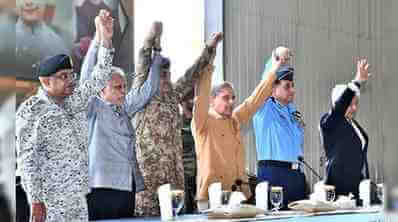
Pakistan Was “Used And Discarded” By US After Afghan Wars: Defence Minister Khawaja Asif
Pakistan Was “Used And Discarded” By US After Afghan Wars: Defence Minister Khawaja Asif
Islamabad: Pakistan’s Defence Minister Khawaja Asif has made a candid admission about Islamabad’s past alignment with the United States, telling Parliament that the country was “used for a purpose and then thrown away like a piece of toilet paper.”
Speaking in Pakistan’s National Assembly, Asif described the country’s involvement in the Afghan wars as a grave mistake and acknowledged that present-day terrorism in Pakistan is a “blowback” of decisions taken by former military rulers.
“Mistakes Committed By Dictators”
Asif said Pakistan often denies its own history of involvement in militancy and conflict, but added that such denial only deepens the crisis.
“We deny our history and do not accept our mistakes. Terrorism is a blowback of the mistakes committed by dictators in the past,” he told lawmakers.
He directly named former military rulers General Zia-ul-Haq and General Pervez Musharraf, saying they joined the Afghan wars “not for the sake of Islam, but to appease a superpower.”
According to Asif, Pakistan’s participation in the anti-Soviet war in the 1980s and later in the US-led war in Afghanistan after the September 11, 2001 attacks left lasting scars on the country.
On The Pak-US Alliance
Reflecting on Pakistan’s post-1999 realignment with Washington, Asif said the decision to support the United States in its war on terror came at a heavy cost.
“The costs of realigning with the US after 1999 were devastating,” he said. “Pakistan was treated worse than a piece of toilet paper and was used for a purpose and then thrown away.”
He noted that while the United States eventually withdrew from Afghanistan, Pakistan continues to grapple with prolonged violence, radicalisation, and economic strain.
“Jihad” Narrative Questioned
The Defence Minister also challenged the long-standing narrative that Pakistan’s involvement in Afghanistan was driven by religious duty.
He acknowledged that Pakistanis were mobilised under the banner of jihad, but described that framing as misleading and deeply damaging.
Asif further claimed that Pakistan’s education system was reshaped during those periods to justify war policies, embedding ideological changes that continue to influence society.
“The losses we suffered can never be compensated,” he said, calling the consequences of those decisions “irreversible.”
His remarks mark one of the starkest public acknowledgements by a senior Pakistani official that past strategic choices — particularly alignment with global powers in regional conflicts — have contributed to the country’s current security challenges.
About the Author

VoM News Desk -is an online web portal in jammu Kashmir offers regional, National & global news.
Latest Posts
- BREAKING: Death Toll in Gaza Rises to 826 Oct 2026
- Renewed War Will Not Change Iran’s Position, Tehran Rules Out Talks Without Conditions: Foreign Minister Abbas Araghchi25 Oct 2026
- Dakar Rally 2027 Cancelled in Saudi Arabia Amid Regional Tensions25 Oct 2026
- Iran Parliament Speaker Mohammad Bagher Ghalibaf Calls for 10% Cut in Gas Consumption Ahead of Winter25 Oct 2026
- Oppo Reno 17 Series India Launch Timeline, Chipsets Tipped25 Oct 2026
- Samsung W27 Design Leaked 25 Oct 2026
- PM Netanyahu Shares AI-Generated Nuclear Explosion Image Over Tel Aviv Ahead of Israel Elections, Yair Golan Accuses Him of Fearmongering25 Oct 2026
- Judge Ravi Kumar Diwakar, Who Awarded 23 Death Sentences, Transferred to Muzaffarnagar Family Court25 Oct 2026
- 13 Arrested in Assam Over Alleged Assault on Bihu Performers, CM Himanta Biswa Sarma Orders Action25 Oct 2026
- Jammu & Kashmir MTS Employees Association Discusses Pay Disparity, Promotion Quota at Jammu Meeting25 Oct 2026