 Follow on Google News
Doda/Rahi Vijay Sharma
CEO Doda’s Order Banning Media Entry in Govt Schools Sparks Outrage
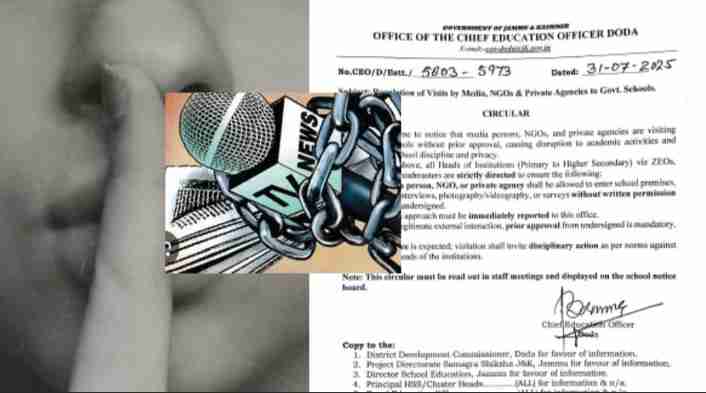
Doda, July 31, 2025 — In a move that has sparked widespread criticism, the Chief Education Officer (CEO) Doda has issued a controversial directive barring media personnel, NGOs, and private agencies from entering government schools without prior written permission. The order, issued under circular No. CEO/D/Estt./5803–5973, mandates that all such visits—whether for interviews, photography, videography, or surveys—must be approved in advance by the CEO’s office.
While the administration defends the decision as a necessary measure to “streamline access and ensure decorum” in educational institutions, the directive has drawn sharp reactions from activists, journalists, and civil society groups who view it as an assault on transparency and accountability.
The timing of the order has especially raised eyebrows, coming at a point when numerous government schools across Doda district continue to grapple with chronic issues such as inadequate infrastructure, shortage of teachers, and a lack of basic facilities for students, particularly in remote areas. Instead of addressing these systemic shortcomings, critics argue, the administration appears to be silencing those who bring such realities to light.
“Instead of addressing the serious issues plaguing the education sector, the authorities have chosen to shoot the messenger,” said a local education rights advocate. “Why are they afraid of the truth coming out? If schools were functioning well, what would they have to hide?”
Journalists have often played a key role in exposing these conditions, prompting public outcry and occasionally forcing administrative responses. However, with this new restriction in place, many fear that even the limited visibility into the system’s failures may now be shut off entirely.
The circular further directs that any approach by external parties must be reported immediately, and that the document be read out in staff meetings and displayed prominently on school notice boards. Non-compliance by heads of institutions may invite disciplinary action, as per departmental norms.
Meanwhile, media professionals in the region have expressed disappointment over what they describe as a growing culture of opacity in public institutions. Several have called for the immediate withdrawal of the order, terming it a violation of press freedom and a disturbing trend toward censorship in a democratic setup.
Despite the clampdown, no new policy initiatives or public commitments have been announced by the administration to tackle the root problems affecting education in the district. Students continue to study in dilapidated buildings without proper sanitation, while parents remain frustrated by the unavailability of teaching staff and educational resources.
The silence on meaningful reforms, juxtaposed with a hasty effort to restrict media scrutiny, has left many asking a troubling question: Is this how the administration defines accountability in education?

Latest Posts
- Ex-Nepal PM KP Sharma Oli Arrested in Connection with Violence in the Gen Z Protest
March 28, 2026 | Breaking News, Politics, World - Government Denies Iran-Linked Fraud Claims in J&K; Fact Check Unit Labels Viral Posts Fake
March 28, 2026 | Breaking News, Jammu Kashmir - Over 96,000 Unorganised Workers in Jammu and Kashmir Enrolled Under PM Pension Scheme: Government of India
March 27, 2026 | Jammu Kashmir - US lawmakers to introduce bill to ban government use of Chinese robots
March 26, 2026 | Breaking News, World - PDP, Chenab Valley Echo Support for Separate Chenab Division
March 26, 2026 | Breaking News - DGPC Jammu Seeks FIR Against Social Media Operator Over Alleged Defamatory Content
March 26, 2026 | Jammu Kashmir - Enhancing Local Outreach, DC Doda Inaugurates Radio Doda 88.8 FM
March 26, 2026 | Doda, Jammu Kashmir - Matt Brittin Takes Over as Director-General of BBC
March 26, 2026 | Breaking News, World - Hormuz Strait Not Fully Closed, Only Restricted to Enemies: Iran
March 26, 2026 | Breaking News, Politics, World - Fugitive Diamond Merchant Nirav Modi Loses Bid to Reopen Extradition Case in London Court
March 26, 2026 | Breaking News, India