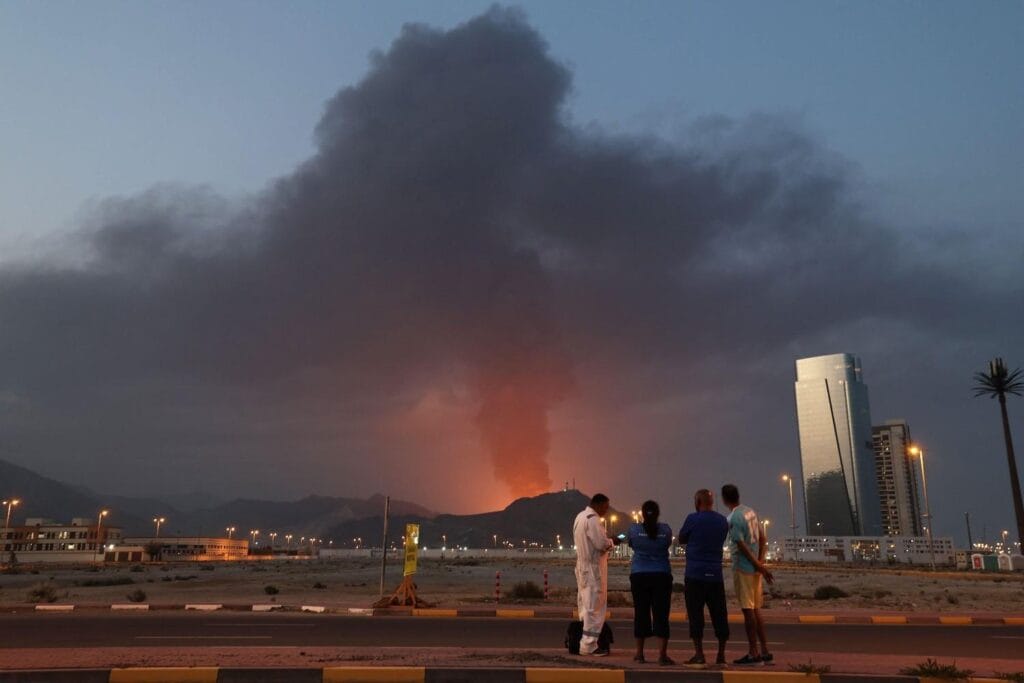
Iran’s Regional Attacks – A Broader Strategy Designed To Expand Pressure On The Global Stage, Beyond the Battlefield
Amid ongoing strikes and rising tensions in the Middle East, analysts say Iran’s recent attacks are not limited to U.S. military bases—they are part of a broader strategy designed to expand pressure on the global stage.
Military experts emphasize that Iran cannot militarily defeat the United States or Israel in a conventional war. Superior weaponry, advanced intelligence capabilities, and international alliances leave Tehran at a disadvantage on the battlefield. Instead, Iran appears to be targeting economic chokepoints and energy routes, seeking to leverage global interdependence to its advantage.
Widening the Battlefield
The Strait of Hormuz, through which roughly 20 percent of the world’s oil passes, is a key target. For energy-dependent countries such as India, which imports over 60 percent of its energy from the Gulf and receives around 2.5–2.7 million barrels per day through the corridor, disruptions have immediate economic consequences.
Rising oil prices, longer shipping routes, and higher insurance premiums could slow trade, increase domestic costs, and create political pressure in capitals far beyond Tehran. Analysts say this is precisely the point: economic disruptions in Dubai, Doha, New Delhi, and Europe can force indirect diplomatic leverage over the United States and Israel.
“By expanding the impact of the conflict to the global economy, Iran forces international actors to pay attention,” said a regional security expert. “This isn’t just retaliation—it’s strategic pressure.”
The Challenge of Regime Change
Beyond immediate military operations, the longer-term goal may involve altering Iran’s internal political dynamics. Experts note that removing leadership does not automatically produce stability. Without a clear, trusted successor, power vacuums could fuel chaos rather than control. Loyalty among the military, the Revolutionary Guard, religious authorities, and the general population is fragmented, leaving succession uncertain.
Analysts caution that while U.S. military operations could destroy critical Iranian infrastructure in weeks, achieving political objectives—especially regime change—is far more complex. Success depends on governance, legitimacy, and control over key institutions, none of which can be secured by airstrikes alone.
Economic Leverage as Strategy
Iran’s strategy, according to analysts, is simple but effective: make the costs of conflict broad enough to generate international pressure for pause or negotiation. Disruptions to oil flows, energy prices, and trade routes extend the battlefield beyond borders and into global markets, buying Tehran strategic breathing room while complicating any plans for rapid regime change.
“The goal isn’t victory on the battlefield,” one analyst said. “It’s leverage. Widen the impact so the world intervenes, and the timelines for political objectives become far more complicated.”
As the war continues, countries heavily reliant on Middle Eastern energy, global markets, and regional trade are already feeling the ripple effects—showing that in modern conflicts, the battlefield extends far beyond borders
About the Author

Dil Bar Irshad is an Indian journalist, writer, and media entrepreneur from the Marmat area of Doda in Jammu and Kashmir, India. He is best known as the founder and Editor-in-Chief of VoM News ("Voice of Masses"), a digital news portal dedicated to highlighting public grievances and citizen issues.Career Overview• Early Career (2015–2016): He began his reporting career focusing on local public issues and citizen grievances in Jammu and Kashmir. • Regional & National Journalism: Over the years, he served as a District Correspondent for the English newspaper Khalsa Express News (2019–2020) and worked as an Urdu correspondent for Sada e Kohistan. He also reported as a J&K Correspondent for the Millennium Post. • International Reporting: In 2023, he expanded into international journalism, working as an India Correspondent for global agencies like BNN Breaking and later TrimFeed, covering diverse topics ranging from stock market updates to regional and global geopolitical developments. • Media Associations: He is an active member of the All India Media Association.Seen IN: Editor-in-Chief, VoM News India, Jammu and Kashmīr Business and Finance, Crime and Justice, Environment As seen in: VoM News, MSN, MSN India, MSN Singapore, MSN UK, Youth Ki Awaaz, Millennium Post, AgroPages, The California Courier, Hecho En California, Justice News, The Chenab Times, Niguro, Sisnoo
Latest Posts
- Repeated Cattle Theft Alone Cannot Justify PSA Detention: Jammu and Kashmir and Ladakh High Court26 Oct 2026
- One of the craziest turnarounds in the history of ODI cricket as Pak Steals Thriller in Tri-nation Series Against England by Shadab’s Splendid 113*(96)26 Oct 2026
- Are Iran-Pakistan Borders Still Open for Bilateral Trade? What Iranian Ambassador To Pakistan Reza Amiri Moghadam Said !!26 Oct 2026
- BREAKING: Death Toll in Gaza Rises to 826 Oct 2026
- Renewed War Will Not Change Iran’s Position, Tehran Rules Out Talks Without Conditions: Foreign Minister Abbas Araghchi25 Oct 2026
- Dakar Rally 2027 Cancelled in Saudi Arabia Amid Regional Tensions25 Oct 2026
- Iran Parliament Speaker Mohammad Bagher Ghalibaf Calls for 10% Cut in Gas Consumption Ahead of Winter25 Oct 2026
- Oppo Reno 17 Series India Launch Timeline, Chipsets Tipped25 Oct 2026
- Samsung W27 Design Leaked 25 Oct 2026
- PM Netanyahu Shares AI-Generated Nuclear Explosion Image Over Tel Aviv Ahead of Israel Elections, Yair Golan Accuses Him of Fearmongering25 Oct 2026