 Follow on Google News
Justice Beyond Punishment: India’s Unfinished Battle Against Sexual Violence
A Crime Against Dignity, Not Just the Body
Rape is not merely a crime against the body. It is an assault on dignity, bodily autonomy, privacy and personal liberty.
In a constitutional democracy, justice cannot be measured only by the severity of punishment written in a statute. True justice begins with prevention, demands a sensitive and professional investigation, requires the protection of evidence and witnesses, ensures a fair prosecution and ultimately depends upon a timely judicial decision.
The Kishtwar Tragedy and the Questions It Raises
The recent tragedy in Kishtwar, Jammu and Kashmir, involving allegations of sexual abuse of a minor schoolgirl and her subsequent death following an alleged attempt to terminate her pregnancy, has deeply disturbed public conscience.
The matter is under investigation, and the allegations must be tested strictly in accordance with law. Yet the case raises a question India cannot continue to avoid: Are our laws inadequate, or are we failing to make the laws already enacted work effectively?
Strong Laws Must Lead to Certain Justice
The Bharatiya Nyaya Sanhita, 2023, contains stringent provisions for serious sexual offences. Section 63 defines rape, while subsequent provisions prescribe severe punishments for aggravated offences, including life imprisonment for the remainder of natural life and, in specified circumstances, the death penalty.
India, therefore, already provides severe punishment for the gravest sexual offences.
Punishment Alone Is Not Justice
A severe sentence cannot compensate for a weak investigation. Evidence may be lost, witnesses may face pressure, forensic reports may be delayed and trials may continue for years.
Justice is not created merely by increasing punishment. It is created when the law is effectively investigated, fairly prosecuted and faithfully enforced.
The Mindset Behind Sexual Violence
The problem also lies beyond the courtroom. Sexual violence is encouraged by attitudes that treat women as objects rather than equal individuals.
It becomes more dangerous when dominance and entitlement are mistaken for masculinity, harassment is normalised, sexist behaviour is dismissed as humour and survivors are blamed for their clothing, movements or choices.
What Society Must Teach
The question should never be, “What was she wearing?” or “Why was she there?” The question should be, “Why did the offender commit the crime?”
Respect for women must be taught at home, in schools and colleges. Children need to understand consent, equality, personal boundaries and responsible behaviour.
Real strength is not domination; it is self-control, respect and the ability to accept another person’s boundaries.
A Respectful Appeal to Parliament and Government
As a law student and citizen, I respectfully urge Parliament and the Government to keep examining whether the legal response to the most serious sexual offences is delivering effective justice.
This is not a demand for punishment without proof, nor should justice be driven solely by public anger. The rule of law must remain supreme.
Justice Must Be Survivor-Centred
A survivor should not have to suffer twice — first because of the crime and then because of an insensitive justice system.
Reporting mechanisms must be accessible and respectful. Investigations should be professional and time-bound. Forensic infrastructure needs continuous improvement. Survivors and witnesses must be protected, while courts should minimise unnecessary delays.
Protecting the Accused and the Survivor
A survivor-centred approach and the accused’s right to a fair trial are not opposing principles.
The accused is entitled to due process; the survivor is entitled to dignity, safety and meaningful access to justice. The credibility of the legal system depends upon protecting both principles.
From Public Outrage to Institutional Accountability
Every horrific incident creates anger, protests and demands for stricter laws. But once the headlines disappear, deeper questions remain:
Was the investigation conducted properly? Was evidence preserved? Were witnesses protected? Did institutions respond responsibly? Were warning signs ignored? Was the trial delayed unnecessarily? Were officials held accountable for serious failures?
These questions must remain central to the national conversation.
Conclusion: Justice Must Be Certain — But Constitutional
India does not simply need harsher laws. India needs a justice system capable of making existing laws work.
We must change attitudes that tolerate disrespect, teach children the meaning of consent, make institutions accountable, strengthen investigation and forensic systems, protect survivors and witnesses, and reduce unnecessary judicial delays.
“The real test of a justice system is not how harshly it can punish after a tragedy, but how effectively it can prevent the next tragedy and deliver lawful justice when one occurs.”
For the worst crimes, justice must be certain, timely and firm — but never outside the Constitution.
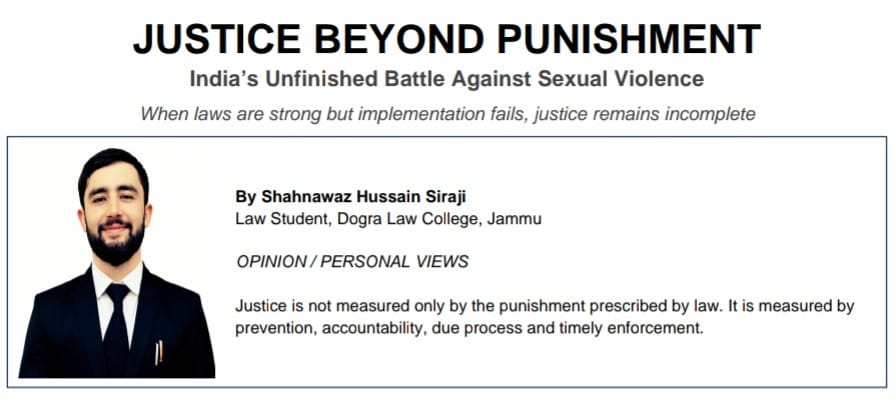
Shahnawaz Hussain Siraji (Law Student, Dogra Law College, Jammu)

Latest Posts
- Research Center for Materials Nanoarchitectonics (MANA) Reveals Atomic-Scale Rails for Guiding Superconducting Vortices
September 25, 2026 | Press Release - Delhi-Bound IndiGo Dreamliner Flight Returns To London After Technical Snag
September 23, 2026 | Breaking News, India - Volkswagen of America, Inc. introduces AirConsole in-vehicle gaming for select model year 2027 vehicles
September 23, 2026 | Press Release - Junaid Family Foundation Sponsors Pakistan’s First International Women’s Tennis Tournament
September 23, 2026 | Breaking News, Sports, World - Jammu Kashmir & Ladakh High Court Cracks Down on Non-Compliance, Issues Warrants Against 3 Pulwama Officers
September 23, 2026 | Breaking News, Courts & Law, Jammu Kashmir - Kishtwar Rape Case; Accused Teacher Dismissed from Service
September 21, 2026 | Breaking News, Jammu Kashmir, Kishtwar - AI Ready School Launches National Research Programme to Measure AI’s Impact on Indian K–12 Education
September 21, 2026 | AI & ML, Breaking News, India, Press Release - MP’s Mandate Is to Be J&K’s Voice, Not Destabilise NC Govt: NC MLA Javed Beg on MP Aga Ruhullah
September 21, 2026 | Breaking News, Jammu Kashmir, Politics - Young Star Cricket Club Doda Announces Free Cricket Trials Across India
September 20, 2026 | Breaking News, Doda, Jammu Kashmir, Sports - Houthis Say Saudi Arabia Targeted Yemen With 26 Strikes In 24 Hours
September 19, 2026 | Breaking News, World