 Follow on Google News
Asiatic Wild Ass Returns to Eastern Mongolia After 65-Year Absence
Hundreds of khulan now documented east of the Trans-Mongolian Railway, demonstrating the success of targeted efforts to restore wildlife connectivity
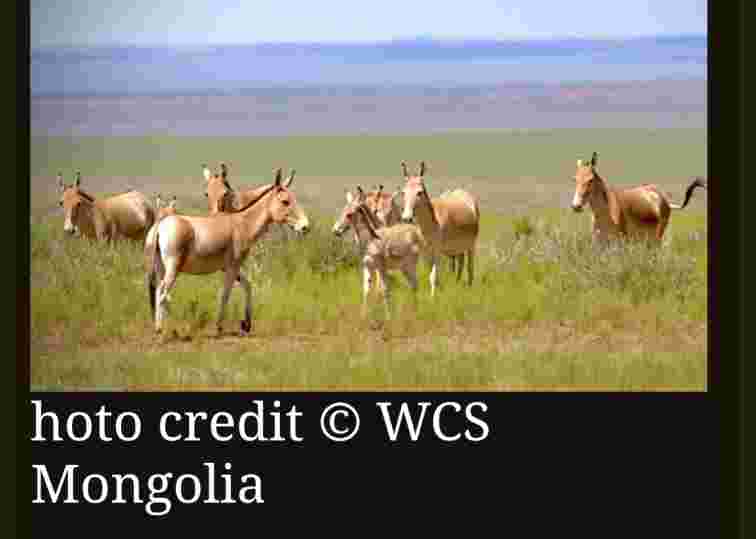
ULAANBAATAR, MONGOLIA, May 1, 2026 — The Asiatic wild ass, known locally as khulan (Equus hemionus), has returned to eastern Mongolia and is showing clear signs of re-establishing a population after more than 65 years of absence from the region.
Findings published this Month in the journal Oryx show that khulan are now regularly present in multiple groups east of the Trans-Mongolian Railway (TMR). For decades, fencing along the railway has restricted movement of khulan and other migratory species. Recent efforts to create safe crossing points are now allowing animals to move more freely across this barrier.
Maintaining connectivity across this landscape is critical for khulan, allowing them to move between seasonal grazing areas and water sources in a highly variable and arid environment, and supporting the broader functioning and resilience of Mongolia’s steppe ecosystem.
Collaborative efforts between WCS and Mongolian government partners have addressed this challenge through several targeted interventions, including testing of temporary unfenced sections along the railway and the formal designation in May 2025 of a monitored “safe passage” zone near the China–Mongolia border kept free of fencing.
Together, these measures appear to be helping khulan cross the railway, including during winter. Monitoring shows that crossings occurred in recent years, and follow-up surveys have since recorded hundreds of khulan on the eastern side. This suggests that khulan are not only passing through, but beginning to re-establish in the region.
Buuveibaatar Bayarbaatar, WCS Senior Scientist and lead author of the study, explained, “Documenting khulan crossing this long-standing barrier and beginning to re-establish in their former range represents an extraordinary conservation breakthrough. It demonstrates that restoring connectivity in fragmented landscapes can support population recovery for wide-ranging species.”
The Mongolian Gobi supports the world’s largest khulan population—approximately 91,000 animals, more than 84 percent of the global total. The species nevertheless faces ongoing threats from habitat fragmentation, competition with livestock, illegal hunting, and climate change. As one of the most wide-ranging terrestrial mammals, khulan require extensive, connected habitats to persist in Mongolia’s variable climate.
“The return of khulan to eastern Mongolia reflects years of collaborative work with provincial authorities, border protection agencies, and railway managers, as well as careful testing of temporary fence gaps that showed wildlife could cross safely without increasing train collisions,” said Justine Shanti Alexander, WCS Mongolia Country Director.
Plans are advancing for a new local protected area east of the railway to support long-term habitat security and khulan recolonization. WCS Temperate Asia Regional Director Jonathan Slaght highlights, “Addressing the fragmentation caused by the railway will not only support the recovery of khulan but also strengthen resilience for other migratory wildlife facing mounting pressures from infrastructure development and climate change.”
[NOTE: In collaboration with the Ministry of Environment and Climate Change of Mongolia, provincial and soum-level governments, and border protection authorities, WCS has advanced wildlife connectivity and khulan recolonization in eastern Mongolia through the vital support of several key partners. We thank Foundation Segre, which funded safe passage and landscape connectivity across the Trans-Mongolian Railway. We also acknowledge Sustainability East Asia and Oyu Tolgoi LLC, whose long-term support underpinned years of khulan research, monitoring, and conservation efforts. We further recognize the ongoing efforts of provincial agencies, local communities, and partners contributing to monitoring and conservation of the khulan across Mongolia.]

Latest Posts
- NUVELL Debuts the World’s First Fully Automatic Home Tofu Maker at IFA 2026
September 7, 2026 | Breaking News, World - Justice Pushpendra Singh Bhati Appointed Chief Justice of Jammu kashmir and Ladakh High Court
September 7, 2026 | Breaking News, Courts & Law, Jammu Kashmir - Peace envoy Jared Kushner & Steve Witkoff Met Volodymyr Zelensky After Meet With Russian Pres. Vladimir Putin
September 7, 2026 | Breaking News, Politics, Russia-Ukraine Conflict, World - Brazil Court Suspends Sigma Lithium Mine Licenses and Operations
September 7, 2026 | Breaking News, World - Indonesia Volcano Eruption: Eight Airports Shut as Anak Krakatau Ash Disrupts Flights
September 7, 2026 | Breaking News, World - Amazon Prime Air Cargo Plane Crashes at Miami Airport, Five Killed
September 7, 2026 | Breaking News, World - DM Doda Orders Complete Ban on Use of VPNs
September 6, 2026 | Breaking News, Doda, Jammu Kashmir - 20-Year-Old BSc Student Bittu Tabahi Takes on Polluted Ajnaar River, Cleans It With His Own Money
September 5, 2026 | Breaking News, Featured by VoM, India - VPNs Banned in Kishtwar, DM Issues Prohibition Order
September 4, 2026 | Breaking News, Jammu Kashmir, Kishtwar - A First for All of Ladakh’s New Districts: They Will Soon Have Elected Hill Councils Under Expanded Ladakh Autonomous Hill Development Council System
September 4, 2026 | Breaking News, Ladakh (Union Territory), Politics