 Follow on Google News
Pusan National University Researchers Reveal How Forest Soil Properties Influence Arsenic Mobility and Toxicity in Soil Organisms
Arsenic contamination in forest soils poses stage-specific risks, as juveniles respond more strongly to mobile arsenic than adults
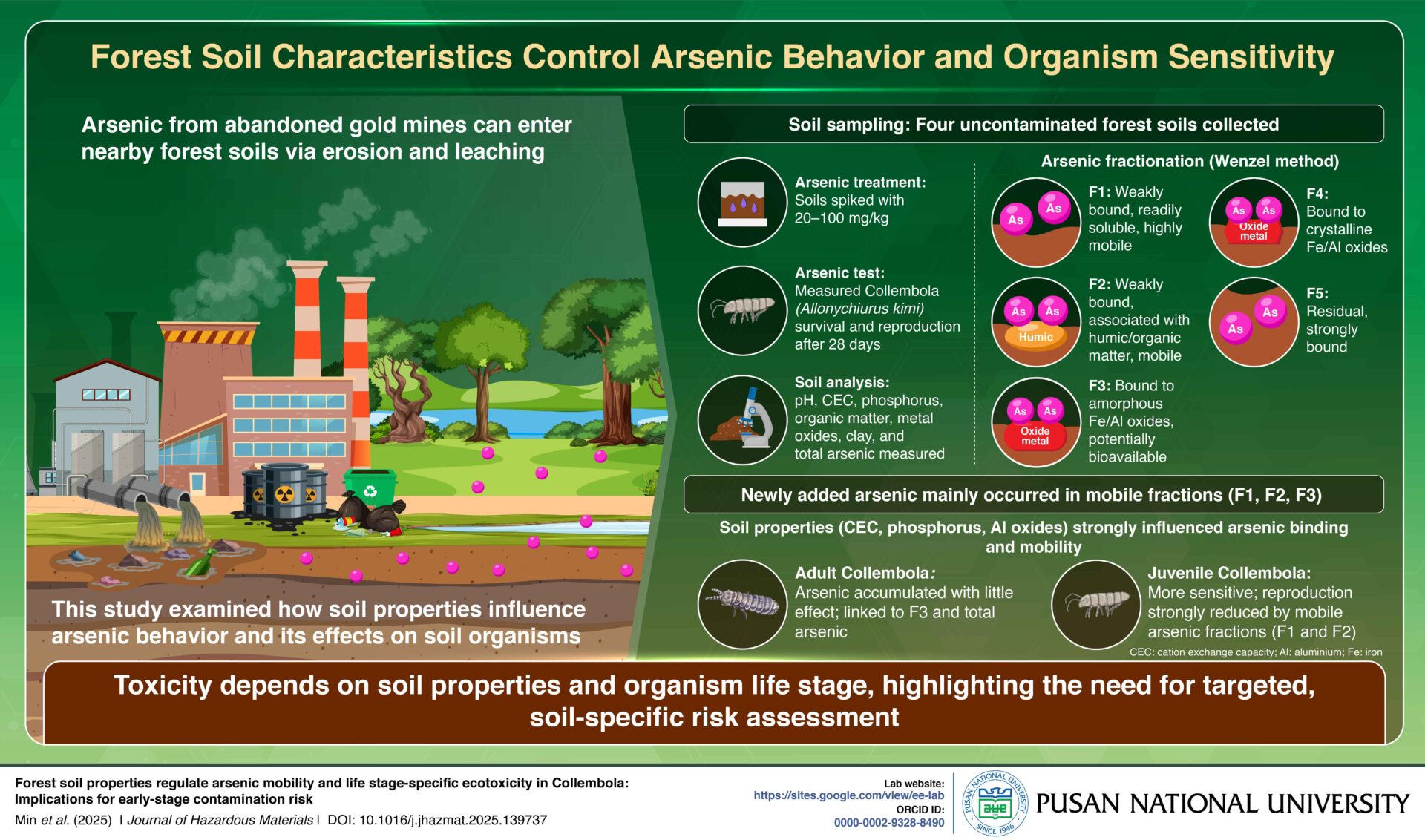
Arsenic leaking from abandoned gold mines can harm forest ecosystems by entering soils and affecting soil organisms. In a recent study, researchers tested forest soils with different chemical properties to see how they influence arsenic mobility and toxicity in springtails. Results showed juveniles were more sensitive to mobile arsenic, while adults responded to total arsenic. These findings highlight the importance of soil chemistry and life stage in arsenic risk assessment.
Soil contamination is a global environmental concern, with toxic metals and metalloids from industrial activities persisting as long-term pollutants. Arsenic (As), although naturally occurring, becomes widespread when mobilized by mining. Abandoned gold mines are major sources, releasing arsenic-rich minerals into surrounding environments through erosion and leaching. Forest soils, essential for ecosystem health and biodiversity, are particularly vulnerable. Despite arsenic’s mobility under specific soil conditions and known toxicity, its behavior in forest soils and impacts on soil organisms remain poorly understood.
In a recent study, a research team led by Professor Yun-Sik Lee from Pusan National University, Korea, investigated how arsenic interacts with different forest soils and how these interactions influence its toxicity to soil-dwelling organisms. As Prof. Lee explains, “Our goal was to determine how soil properties affect arsenic binding, mobility, and bioavailability, and how these factors in turn impact the survival and reproduction of the springtail Allonychiurus kimi (A. kimi), an important indicator species for soil health.” The findings were made available online on 1 September 2025 and was published in Volume 497 of the Journal of Hazardous Materials on 5 October, 2025.
The study collected four uncontaminated forest soils and characterized their physicochemical properties, including pH, cation exchange capacity (CEC), phosphorus content, organic matter, metal oxides, clay content, and total arsenic. Soil samples were spiked with arsenic at 20–100 mg/kg and aged under wet-dry cycles to simulate environmental contamination. Using the Wenzel sequential extraction method, arsenic was fractionated into F1 and F2 (weakly bound, highly mobile), F3 (bound to amorphous Fe/Al oxides, potentially bioavailable), F4 (bound to crystalline Fe/Al oxides), and F5 (residual, strongly bound). Adult and juvenile A. kimi were exposed to these soils for 28 days to assess arsenic accumulation, survival, and reproduction.
Results showed that newly introduced arsenic primarily accumulated in mobile fractions (F1–F3), making it bioavailable to soil organisms. Prof. Lee notes, “Even at the same total arsenic concentration, contamination levels and biotoxicity varied markedly depending on soil properties. CEC, phosphorus, and aluminum oxides strongly influenced arsenic binding and mobility.” Life stage strongly affected toxicity: adults accumulated arsenic without significant impacts on survival, with body burdens correlating more with F3 and total arsenic levels. Juveniles were highly sensitive, with reproduction strongly reduced by mobile arsenic fractions, highlighting vulnerability during early development.
This research improves understanding of arsenic bioavailability and toxicity in forest soils. “The findings support the development of more accurate ecotoxicological assessments that account for differential sensitivity between juveniles and adults,” explains Prof. Lee. He adds, “Moreover, the study emphasizes the need for soil-specific risk evaluations based on bioavailable arsenic fractions rather than total concentrations, providing a stronger foundation for targeted ecosystem management and remediation strategies.”
In conclusion, the study demonstrates that arsenic behavior in forest soils is controlled by soil properties and that toxicity varies according to chemical fraction and life stage. These insights provide a basis for soil-specific management and remediation strategies to protect ecosystems from arsenic contamination.

Latest Posts
- Leh Designated as Place for High Court Sittings in Ladakh
October 5, 2026 | Breaking News, Courts & Law, Jammu Kashmir - Army Personnel Among 8 Held in Madras Regiment Arms Heist; Telangana Police Recover Weapons
October 5, 2026 | Breaking News, India, Politics - DMK To File Rs 1 Crore Defamation Case Against Tamilaga Vettri Kazhagam Over R Veeramani Claims
October 5, 2026 | Breaking News, India, Politics - Jammu and Kashmir Cricket Association Names 18 Players for Ranji Trophy 2026-27 Preparatory Camp in Srinagar
October 5, 2026 | Breaking News, Sports - Yemen Launches Dawn of Yemen Operation Aimed at Retaking Capital Sanaa From Houthis
October 5, 2026 | Breaking News, World - Punjab and Haryana High Court Orders CBI Probe Into Corruption Allegations Linked to OSD of CM Bhagwant Mann
October 5, 2026 | Breaking News, Courts & Law, India, Politics - Yemen Government Forces Claim Control of Bab al-Mandeb Strait, Recapture Dhubab Airport
October 5, 2026 | Breaking News, World - National Human Rights Commission (NHRC) Directs States, UTs to Protect Street Vendors’ Livelihoods During Navratri, Diwali and Chhath Puja
October 5, 2026 | Breaking News, India - Indian Stock Market Opens Sharply Higher, Sensex Jumps Over 400 Points, Nifty Tops 22,500
October 5, 2026 | Breaking News, Business - NEP 2020 and Zoology: Transforming Biological Education for a Sustainable Future | By Dr. Wahied Khawar Balwan
October 5, 2026 | Articles/Editorials, Featured by VoM