 Follow on Google News
How Zebrafish Might Be Key to Unlocking Treatments for CADASIL ?
Researchers have developed a zebrafish model that reproduces key features of an inherited neurodegenerative disorder
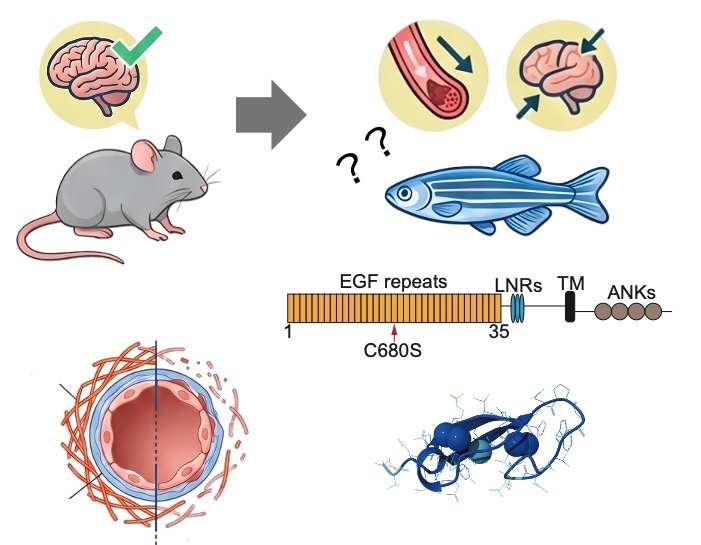
CADASIL, an inherited disease caused by mutations in the NOTCH3 gene, damages the brain’s small blood vessels, leading to strokes, cognitive decline, and early dementia. Despite decades of research, its underlying disease mechanisms remain poorly understood due to the lack of suitable disease models. To tackle this issue, researchers have developed the world’s first zebrafish model of CADASIL, which reproduces several key features of the disease. Their findings will help identify potential therapeutic targets.
CADASIL, which stands for ‘cerebral autosomal dominant arteriopathy with subcortical infarcts and leukoencephalopathy,’ is a hereditary disease that damages the brain’s small blood vessels, causing recurrent strokes. Over time, CADASIL leads to a decline in cognitive functions and can progress to early-onset dementia, even in young patients. While scientists have known for decades that the disease is caused by mutations in a gene called NOTCH3, no effective treatment exists yet, as we still do not fully understand why and how the disease progresses at the biological level.
One reason for this knowledge gap is the lack of animal models that can accurately reproduce the disease in the laboratory. Existing mouse models can replicate some features of CADASIL, but they fail to show important symptoms seen in patients, such as significant memory decline, brain atrophy, and white matter lesions. Against this backdrop, scientists investigated whether zebrafish—a small freshwater fish increasingly used in biomedical research—could offer a better way to investigate this disorder.
Seeking to answer this question, a research team led by Professor Motoyuki Itoh from the Graduate School of Pharmaceutical Sciences at Chiba University, Japan, set out to develop the world’s first zebrafish model of CADASIL. The paper was co-authored by Dr. Tohgo Kanoh from Chiba University, Dr. Ichio Aoki from the National Institutes for Quantum Science and Technology (QST), Japan, and Dr. Yoshinori Hasegawa and Dr. Osamu Ohara from Kazusa DNA Research Institute, Japan. Their latest study, published in Acta Neuropathologica Communications on June 3, 2026, describes how zebrafish carrying a specific NOTCH3 mutation was able to replicate the key features of the disease in ways that previous animal models could not.
The researchers worked with zebrafish carrying a mutation called p.C680S in the NOTCH3 gene, which mirrors a mutation associated with CADASIL in humans. They closely followed the animals as they aged, using live imaging to monitor blood flow in the brain and behavioral tests to assess learning and memory. They also performed magnetic resonance imaging to visualize brain structure and molecular analyses to examine changes in gene and protein activity.
From 11 months of age, the mutant zebrafish showed a progressive decline in cerebral blood flow. By 14 months, learning ability had dropped significantly, and working memory was impaired by 17 months. This followed a similar sequence of deterioration seen in actual patients. Brain scans confirmed tissue loss in a region of the brain equivalent to the human cerebrum, and electron microscopy revealed characteristic abnormal protein deposits known as granular osmiophilic material—a hallmark sign of CADASIL.
READ THIS: Global Flourishing Study Maps the Topography of the Human Experience
To understand what was driving these changes, the team performed detailed molecular analyses of gene and protein expression in the zebrafish brains. They found a consistent reduction in type IV collagen, which is a structural protein that forms a supportive mesh around blood vessels and helps keep them strong, intact, and flexible. Less type IV collagen was present around the cerebral blood vessels of the mutant zebrafish, and the vascular basement membrane that supports blood vessel walls appeared structurally disrupted.
“Our study provides new insights into the relationship between CADASIL-causing gene mutations and type IV collagen. The results may thus help identify new therapeutic targets for this disease,” remarks Prof. Itoh.
Overall, this work showcases the untapped potential of zebrafish in the study of neurodegenerative diseases. “Over the next 5 to 10 years, we expect various new zebrafish models with different CADASIL mutations to be developed and used to discover new therapies and evaluate their effectiveness. This breakthrough is also leading to a wider recognition of zebrafish as a model for age-related dementia,” concludes Prof. Itoh.
For patients and families affected by CADASIL worldwide, particularly in East Asia, where certain mutations are especially prevalent, this research marks a meaningful step toward treatments that have so far remained out of reach.
To see more news from Chiba University, click here.
About Professor Motoyuki Itoh from Chiba University, Japan
Professor Motoyuki Itoh obtained a Master’s degree in Pharmaceutical Sciences from Osaka University in 1993 and a PhD degree in Medicine from Osaka University in 1998. He currently serves as a Full Professor at the Graduate School of Pharmaceutical Sciences, Chiba University. His work focuses on the molecular and cellular mechanisms of Notch signaling, age-related neurological diseases, and cerebrovascular biology, with particular interest in using zebrafish as a model organism. He has published over 70 research papers on these topics. He is also a member of several academic societies, including The Molecular Biology Society of Japan, The Pharmaceutical Society of Japan, and the Society for Neuroscience (SfN).
Funding:
The authors declare that financial support was received for the research, authorship, and publication of this article. This work was supported by JSPS Grant-in-Aid for JSPS Fellows Grant Numbers JP25KJ0721, JST SPRING Grant Number JPMJSP2109, Innovative Medicine CHIBA Doctoral WISE Program; JSPS KAKENHI Grant Numbers JP18H02568, JP21H02621, and JP25K09486. JSPS Program for Forming Japan’s Peak Research Universities (J-PEAKS) Grant Number JPJS00420230002.
Reference:
Title of original paper: Age-dependent vascular and neurological characteristics of CADASIL are recapitulated in Notch3 mutant zebrafish, implicating a role for type IV collagen in disease progression
Authors: Tohgo Kanoh1, Shiho Oubayashi1, Kengo Furukawa1, Kosuke Fujimoto1, Amane Inoue1, Takamasa Mizoguchi1, Masashi Yamaguchi2, Azusa Takahashi-Nakaguchi2, Yoshinori Hasegawa3, Osamu Ohara3, Ichio Aoki4, and Motoyuki Itoh1,5,6
Affiliations: (1) Graduate School of Pharmaceutical Sciences, Chiba University; (2) Medical Mycology Research Center, Chiba University; (3) Department of Applied Genomics, Kazusa DNA Research Institute; (4) Institute for Quantum Medical Science, National Institutes for Quantum Science and Technology; (5) Research Institute of Disaster Medicine, Chiba University; (6) Health and Disease Omics Center, Chiba University
Journal: Acta Neuropathologica Communications
DOI: 10.1186/s40478-026-02333-8
Expert Contact: Motoyuki Itoh
Graduate School of Pharmaceutical Sciences, Chiba University
Email: mito@chiba-u.jp
Media Contact: Academic Research & Innovation Management Organization (IMO), Chiba University
Address: 1-33 Yayoi, Inage, Chiba 263-8522 Japan
Email: ymasshardt@faculty.gs.chiba-u.jp

Latest Posts
- Leh Designated as Place for High Court Sittings in Ladakh
October 5, 2026 | Breaking News, Courts & Law, Jammu Kashmir - Army Personnel Among 8 Held in Madras Regiment Arms Heist; Telangana Police Recover Weapons
October 5, 2026 | Breaking News, India, Politics - DMK To File Rs 1 Crore Defamation Case Against Tamilaga Vettri Kazhagam Over R Veeramani Claims
October 5, 2026 | Breaking News, India, Politics - Jammu and Kashmir Cricket Association Names 18 Players for Ranji Trophy 2026-27 Preparatory Camp in Srinagar
October 5, 2026 | Breaking News, Sports - Yemen Launches Dawn of Yemen Operation Aimed at Retaking Capital Sanaa From Houthis
October 5, 2026 | Breaking News, World - Punjab and Haryana High Court Orders CBI Probe Into Corruption Allegations Linked to OSD of CM Bhagwant Mann
October 5, 2026 | Breaking News, Courts & Law, India, Politics - Yemen Government Forces Claim Control of Bab al-Mandeb Strait, Recapture Dhubab Airport
October 5, 2026 | Breaking News, World - National Human Rights Commission (NHRC) Directs States, UTs to Protect Street Vendors’ Livelihoods During Navratri, Diwali and Chhath Puja
October 5, 2026 | Breaking News, India - Indian Stock Market Opens Sharply Higher, Sensex Jumps Over 400 Points, Nifty Tops 22,500
October 5, 2026 | Breaking News, Business - NEP 2020 and Zoology: Transforming Biological Education for a Sustainable Future | By Dr. Wahied Khawar Balwan
October 5, 2026 | Articles/Editorials, Featured by VoM