 Follow on Google News
Blue Origin Launches New Glenn on First Customer Mission, Sends NASA Mars Satellites on 22-Month Journey
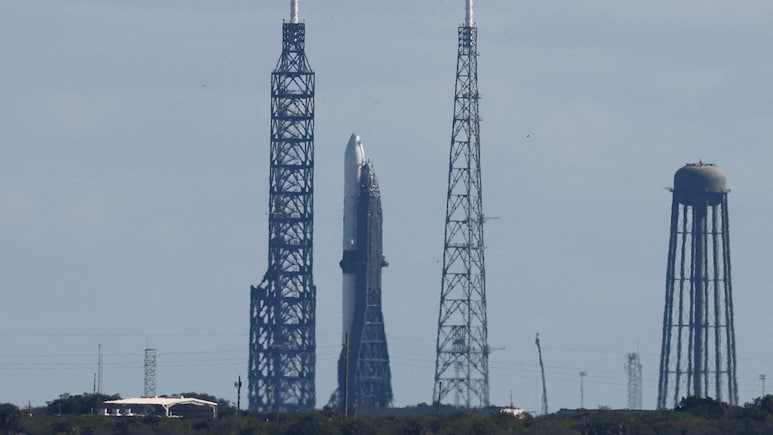
Blue Origin marked a major milestone on Thursday, launching its giant New Glenn rocket on its first mission for paying customers. The heavy-lift vehicle, developed by Jeff Bezos’ space company, roared off the pad at Cape Canaveral Space Force Station in Florida, carrying two NASA-backed satellites bound for Mars.
The 32-story rocket lifted into the sky moments after its seven BE-4 engines ignited, consuming more than 2,800 pounds of liquid fuel every second. The launch came after several weather-related delays, including cloudy conditions and a geomagnetic storm earlier in the week.
Aboard the rocket were NASA’s twin EscaPADE spacecraft — known as Blue and Gold — designed to orbit Mars and study how solar winds interact with the planet’s magnetic field and thin atmosphere. The probes were scheduled to separate from New Glenn’s upper stage roughly 30 minutes after liftoff, beginning a 22-month cruise to the Red Planet. Once there, they’ll conduct an 11-month synchronized study of Martian space weather.
The mission also carried a small payload for Viasat, which will remain attached to the upper stage to demonstrate an in-space communications relay above Earth.
New Glenn’s reusable first stage was programmed to return to a barge in the Atlantic, a maneuver that failed during its inaugural test flight in January due to an engine malfunction. The booster’s performance on Thursday will be evaluated as part of Blue Origin’s ongoing attempt to match SpaceX’s reusability standards.
A Delayed Mission Finally Takes Flight
EscaPADE was originally expected to launch in October 2024 but was pushed back more than a year because of setbacks in New Glenn’s development. When the rocket made its maiden flight in January, it carried an internal payload — a prototype of the Blue Ring satellite platform — instead of customer spacecraft.
The two Mars-bound satellites were built by Rocket Lab with scientific instruments supplied by the University of California, Berkeley.
Blue Origin Takes on SpaceX
Thursday’s launch represents Blue Origin’s first major science mission for an external customer, a crucial step as the company attempts to compete with Elon Musk’s SpaceX, which has dominated the commercial launch sector. SpaceX has flown nearly 280 Falcon missions in the past two years alone, many supporting its Starlink satellite network.
New Glenn, which has cost billions to develop, is designed as Blue Origin’s flagship rocket for future crewed and cargo missions. It produces twice the liftoff thrust of SpaceX’s Falcon 9 and offers cargo capacity comparable to the Falcon Heavy.
NASA paid about $55 million for the EscaPADE mission and an additional $18 million for the New Glenn launch, according to federal records.
Beyond Thursday’s Launch
Blue Origin continues to expand its footprint in the aerospace industry. The company builds engines for United Launch Alliance’s Vulcan Centaur rocket, is developing a crewed lunar lander for NASA’s Artemis program, and is involved in plans for a future commercial space station.
Still, it faces a steep climb to catch up with SpaceX, which is also testing its next-generation Starship — a fully reusable stainless-steel rocket designed for missions to the moon, Mars, and beyond. If Starship becomes operational at scale, it would be the most powerful rocket ever built.
For now, New Glenn’s successful customer debut marks a turning point for Bezos’ space venture, signaling that Blue Origin is finally stepping into the competitive heavy-launch arena.

Latest Posts
- Over 96,000 Unorganised Workers in Jammu and Kashmir Enrolled Under PM Pension Scheme: Government of India
March 27, 2026 | Jammu Kashmir - US lawmakers to introduce bill to ban government use of Chinese robots
March 26, 2026 | Breaking News, World - PDP, Chenab Valley Echo Support for Separate Chenab Division
March 26, 2026 | Breaking News - DGPC Jammu Seeks FIR Against Social Media Operator Over Alleged Defamatory Content
March 26, 2026 | Jammu Kashmir - Enhancing Local Outreach, DC Doda Inaugurates Radio Doda 88.8 FM
March 26, 2026 | Doda, Jammu Kashmir - Matt Brittin Takes Over as Director-General of BBC
March 26, 2026 | Breaking News, World - Hormuz Strait Not Fully Closed, Only Restricted to Enemies: Iran
March 26, 2026 | Breaking News, Politics, World - Fugitive Diamond Merchant Nirav Modi Loses Bid to Reopen Extradition Case in London Court
March 26, 2026 | Breaking News, India - Iran’s Powerful Parliament Speaker Mohammad Bagher Ghalibaf Warns of Possible Attack on Iran Island Amid Rising Gulf Tensions
March 26, 2026 | Breaking News, Politics, World - India Retains 4 Percent Retail Inflation Target for Next Five Years Till 2031
March 26, 2026 | Breaking News, India