
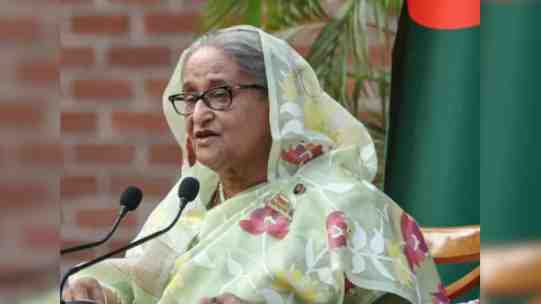
Sheikh Hasina Questions Bangladesh Poll Credibility From India, Warns of Deepening Instability
New Delhi/Dhaka: Bangladesh’s ousted Prime Minister Sheikh Hasina, currently in exile in India, has strongly criticised the country’s upcoming national election, warning that barring her party from the process risks pushing the nation into prolonged political instability.
In remarks sent via email to The Associated Press last week, Hasina said the February 12 election—widely viewed as Bangladesh’s most critical vote in decades—cannot be considered credible or democratic without broad political inclusion. Her comments come after the former ruling Awami League was barred from contesting the polls by the interim administration.
Hasina accused the caretaker government led by Nobel Peace Prize laureate Muhammad Yunus of deliberately excluding millions of voters by preventing her party from participating. “When a significant section of society is denied political participation, it breeds resentment, erodes institutional legitimacy and lays the groundwork for future unrest,” she wrote, adding that “a government formed through exclusion cannot unify a fractured nation.”
More than 127 million Bangladeshis are eligible to vote in the February election, the first since Hasina was removed from power following a mass student-led uprising in 2024 that ended her 15-year rule. Hasina later fled to India on August 5, 2024, amid violent unrest, and was subsequently sentenced to death in absentia over her government’s crackdown on protests that reportedly killed hundreds.
Yunus assumed office days after Hasina’s departure, pledging to restore democratic norms and oversee a free and fair election. His administration is also pushing a proposed constitutional referendum that could usher in sweeping political reforms. Campaigning began last week with rallies across Dhaka and other major cities.
Despite assurances from the interim government, doubts persist over the fairness and inclusivity of the process. Critics have raised concerns about security, the scope of the referendum, and the exclusion of the Awami League from the electoral arena.
In a statement to the AP, Yunus’ office said security forces would ensure an orderly vote and prevent coercion or violence. The administration has invited international observers and human rights groups to monitor the polls. The Election Commission has said around 500 foreign observers, including delegations from the European Union and the Commonwealth, are expected to be present.
Since Hasina’s ouster, Bangladesh has faced mounting political and security challenges. Human rights organisations and minority groups have accused the interim authorities of failing to safeguard civil liberties, while the Awami League has alleged arbitrary arrests and custodial deaths of its members—claims the government has denied.
Alarm has also grown over the increasing visibility of Islamist groups, attacks on minorities—particularly Hindus—and pressure on the media. Several journalists have faced criminal cases, and the offices of leading newspapers have been targeted by protesters, raising fears over press freedom.
As the election approaches, the Bangladesh Nationalist Party (BNP), led by Tarique Rahman, has emerged as the frontrunner. Rahman, the son of former Prime Minister Khaleda Zia, returned to Bangladesh in December after more than 17 years in exile and has pledged to work toward national stability. His principal challenger is an alliance of 11 parties led by the Islamist Jamaat-e-Islami.
Under Hasina’s tenure, Jamaat-e-Islami faced severe restrictions, with several senior leaders executed or jailed over war crimes linked to the 1971 independence war. The BNP, meanwhile, boycotted elections in 2014 and 2024 and later alleged rigging in the 2018 polls.
Hasina has long been criticised by opponents and rights groups for overseeing an increasingly authoritarian system, marked by suppression of dissent and allegations of enforced disappearances. However, she has dismissed the court that sentenced her to death as a “kangaroo court,” with international rights organisations also questioning the fairness of the trial.
In her message, Hasina acknowledged that some elections held under her government lacked full participation due to boycotts by rival parties, calling the situation “far from ideal.” She urged Bangladesh’s political forces to end the cycle of bans and boycotts, warning that continued exclusion would leave the country without “redemption.”
“Bangladesh needs a legitimate government that rules with the genuine consent of its people,” she said, adding that only such a mandate can help the nation heal and move forward.
About the Author

VoM News Desk -is an online web portal in jammu Kashmir offers regional, National & global news.
Latest Posts
- BREAKING: France Protests 2026; Night Curfews Imposed in Four Cities After Violent Protests19 Oct 2026
- BREAKING: GREF Porter Killed, 3 Critically Injured in Poonch Landslide19 Oct 2026
- Indian Embassy in Italy Issues Advisory Amid Protests, Urges Nationals to Avoid Crowded Areas19 Oct 2026
- Control Resonant Sells 1 Million Copies in Three Weeks, Becomes Remedy’s Fastest-Selling Game19 Oct 2026
- CJP Leaders Ashutosh Ranka, Saurav Das Remain in Tihar as Judicial Custody Extended by Two Days19 Oct 2026
- Delhi Police Files Chargesheet Against 7 In Death Case of Manipur Musician Chongtham Vikram Singh19 Oct 2026
- WCS Welcomes New IUCN Report Calling for Ecological Integrity to Be at the Heart of Global Conservation Efforts19 Oct 2026
- Jersey City Police Make 27 Gun-Related Arrests Since September19 Oct 2026
- Stone Thrown at Srinagar-Bound Passenger Bus in Ludhiana, Punjab; Police Launch Probe19 Oct 2026
- Around 2.7 Lakh Students to Appear in JKBOSE Class 10, 11 and 12 Exams19 Oct 2026