 Follow on Google News
ISRO Collects Advanced Chandrayaan-2 Data To Study Moon’s Polar Regions
ISRO on Saturday said it has collected advanced data from the Chandrayaan-2 lunar orbiter to gain a deeper understanding of the Moon’s polar regions, including parameters describing the physical and dielectric properties of its surface.
This is India’s major value addition towards future global exploration of the Moon, it said.
According to an ISRO statement, the Chandrayaan-2 Orbiter has been in orbit around the Moon since 2019 and has been providing high-quality data.
One of the payloads, the Dual Frequency Synthetic Aperture Radar (DFSAR), is the first instrument that has mapped the Moon using the L-band in full-polarimetric mode and in the highest resolution (25m/pixel).
This advanced radar mode sends and receives signals in both vertical and horizontal directions, making it ideal for studying surface properties, it said.
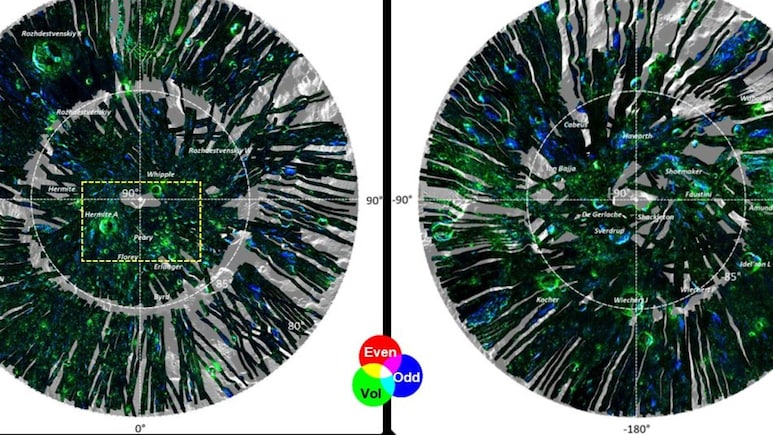
The space agency said that since its launch, about 1,400 radar datasets have been collected and processed to create polarimetric mosaics of the north and south polar regions (80 to 90 degrees latitude) of the Moon.
“Using the datasets, scientists from the Space Applications Centre (SAC), Ahmedabad, have developed advanced data products on the potential presence of water-ice, surface roughness, as well as an important electrical property, namely the dielectric constant, which describes features like density and porosity of the Moon’s surface,” it said.
The algorithm for analysing the full-polarimetric data has been developed, and the data products have been generated indigenously by ISRO, the space agency said.
ISRO said these advanced data products are significant in view of gathering first-order information about the Moon’s polar regions.
Such regions are expected to have preserved the early chemical conditions of the solar system, which are important clues to explain several facets of the evolution of planetary bodies.
“This kind of ready-to-use data product on lunar polar regions has always been sought after, because it will provide holistic information to characterise the polar regions for future lunar exploration. These products complement hyperspectral data in studying the distribution of minerals on the Moon,” it stated.
The space agency said the polar mosaics include key radar parameters that reveal the physical and electrical (dielectric) characteristics of the Moon’s surface and subsurface.
“The derived Polar Mosaic products (Level 3C) are released for users and are freely available on the Indian Space Science Data Centre (ISSDC) PRADAN website,” it added.
(Except for the headline, this story has not been edited by VoM News staff and is published from the syndicated feed)

Latest Posts
- Kishtwar Rape Case; Accused Teacher Dismissed from Service
September 21, 2026 | Breaking News, Jammu Kashmir, Kishtwar - AI Ready School Launches National Research Programme to Measure AI’s Impact on Indian K–12 Education
September 21, 2026 | AI & ML, Breaking News, India, Press Release - MP’s Mandate Is to Be J&K’s Voice, Not Destabilise NC Govt: NC MLA Javed Beg on MP Aga Ruhullah
September 21, 2026 | Breaking News, Jammu Kashmir, Politics - Young Star Cricket Club Doda Announces Free Cricket Trials Across India
September 20, 2026 | Breaking News, Doda, Jammu Kashmir, Sports - Houthis Say Saudi Arabia Targeted Yemen With 26 Strikes In 24 Hours
September 19, 2026 | Breaking News, World - BREAKING: US Clears Multibillion-Dollar Air Defence Sale to Kyiv
September 19, 2026 | Breaking News, World - Fire Reported Near Riyadh Airport in Saudi Arabia Amid Yemen Fighting
September 19, 2026 | Breaking News, World - Leading British-Pakistani consultant Urologist Dr Muhammad Shabi Ahmed honoured for advancing urology and supporting disadvantaged patients in Pakistan
September 19, 2026 | Breaking News, World - Fincom raises $20m to make remittances faster and cheaper
September 19, 2026 | Business, World - Delhi Police Bust 3 Fake International Call Centres, 23 Arrested
September 18, 2026 | Breaking News, India, Politics